

A careful examination of large behavior models for multitask dexterous manipulation
Jose Barreiros, Andrew Beaulieu, Aditya Bhat, Rick Cory, Eric Cousineau, Hongkai Dai, Ching-Hsin Fang, Kunimatsu Hashimoto, Muhammad Zubair Irshad, Masha Itkina, Naveen Kuppuswamy, Kuan-Hui Lee, Katherine Liu, Dale McConachie, Ian McMahon, Haruki Nishimura, Calder Phillips-Grafflin, Charles Richter, Paarth Shah, Krishnan Srinivasan, Blake Wulfe, Chen Xu, Mengchao Zhang, Alex Alspach, Maya Angeles, Kushal Arora, Vitor Campagnolo Guizilini, Alejandro Castro, Dian Chen, Ting-Sheng Chu, Sam Creasey, Sean Curtis, Richard Denitto, Emma Dixon, Eric Dusel, Matthew Ferreira, Aimee Goncalves, Grant Gould, Damrong Guoy, Swati Gupta, Xuchen Han, Kyle Hatch, Brendan Hathaway, Allison Henry, Hillel Hochsztein, Phoebe Horgan, Shun Iwase, Donovon Jackson, Siddharth Karamcheti, Sedrick Keh, Joseph Masterjohn, Masayuki Masuda, Jean Mercat, Patrick Miller, Paul Mitiguy, Tony Nguyen, Jeremy Nimmer, Yuki Noguchi, Reko Ong, Aykut Onol, Owen Pfannenstiehl, Richard Poyner, Leticia Priebe Mendes Rocha, Gordon Richardson, Christopher Rodriguez, Derick Seale, Michael Sherman, Mariah Smith-Jones, David Tago, Pavel Tokmakov, Matthew Tran, Basile Van Hoorick, Igor Vasiljevic, Sergey Zakharov, Mark Zolotas, Rareș Ambruș, Kerri Fetzer-Borelli, Benjamin Burchfiel, Hadas Kress-Gazit, Siyuan Feng, Stacie Ford, Russ Tedrake
Science Robotics 2026
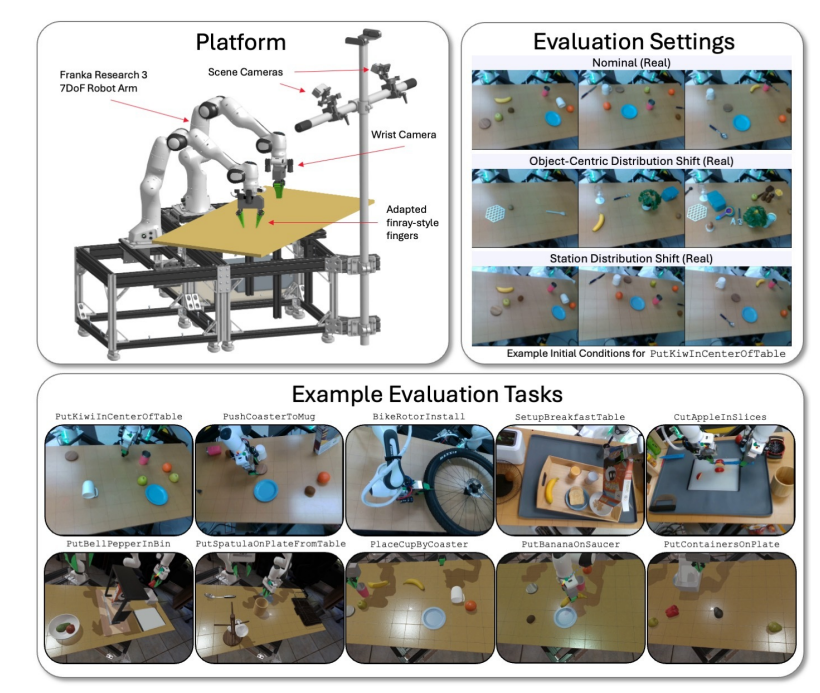
Robot manipulation has seen tremendous progress in recent years, with imitation learning policies enabling successful performance of dexterous and hard-to-model tasks. Concurrently, scaling data and model size has led to the development of capable language and vision foundation models, motivating large-scale efforts to create general-purpose robot foundation models. Although these models have garnered considerable enthusiasm and investment, meaningful evaluation of real-world performance remains a challenge, limiting the pace of development and inhibiting a nuanced understanding of current capabilities. Here, we rigorously evaluated multitask robot manipulation policies, referred to as large behavior models, by extending the diffusion policy paradigm across a corpus of simulated and real-world robot data. We proposed and validated an evaluation pipeline to rigorously analyze the capabilities of these models with statistical confidence. We compared against single-task baselines through blind, randomized trials in a controlled setting, using both simulation and real-world experiments. We found that multitask pretraining made the policies more successful and robust and enabled teaching complex new tasks more quickly, using a fraction of the data when compared with single-task baselines. Moreover, performance predictably increased as pretraining scale and diversity grows.

FastMap: Revisiting Structure from Motion through First-Order Optimization
Jiahao Li, Haochen Wang, Muhammad Zubair Irshad, Igor Vasiljevic, Matthew R. Walter, Vitor Campagnolo Guizilini, Greg Shakhnarovich
3DV 2026 (Best Paper Finalist)
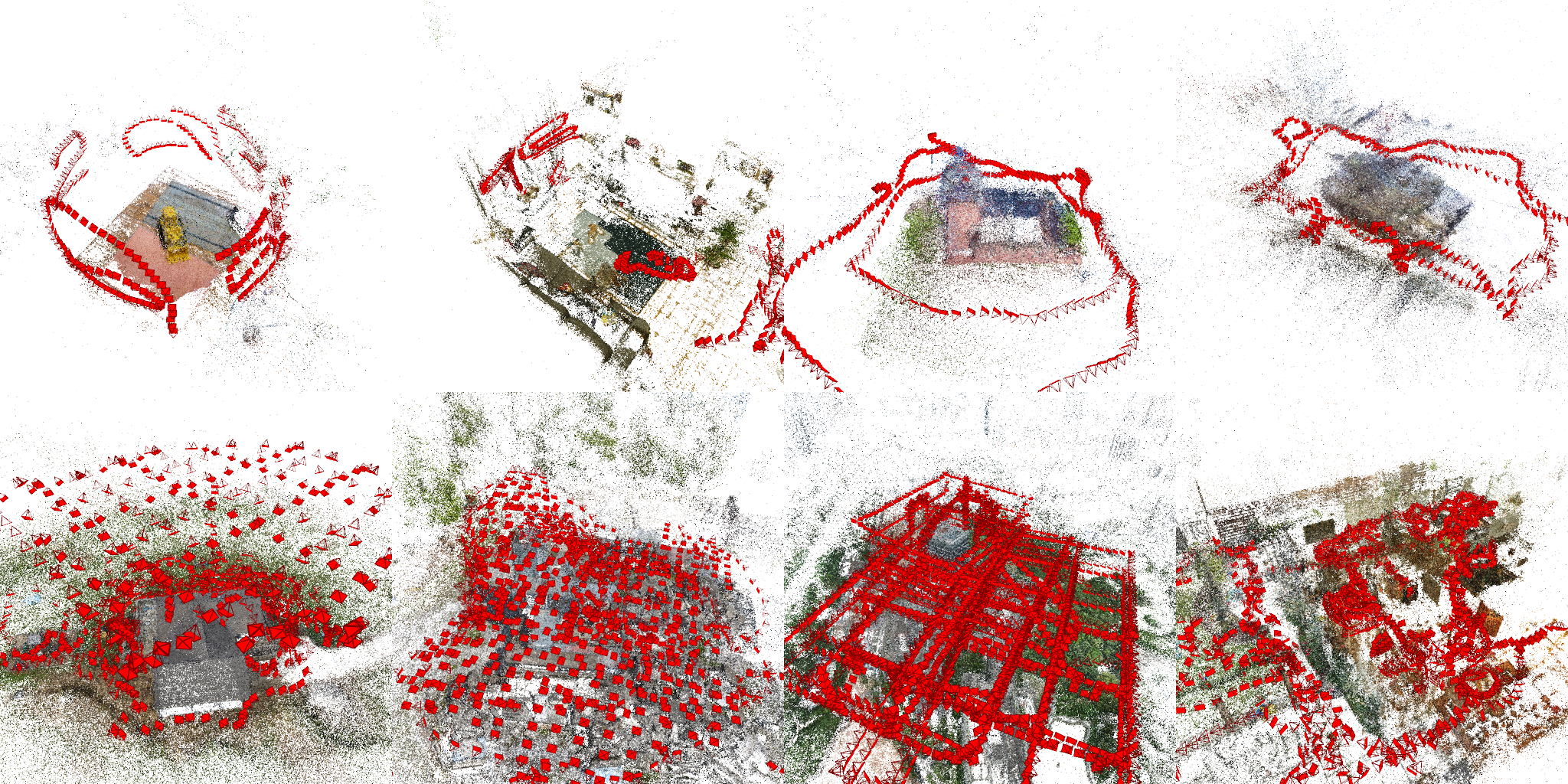
We propose FastMap, a new global structure from motion method focused on speed and simplicity. Previous methods like COLMAP and GLOMAP are able to estimate high-precision camera poses, but suffer from poor scalability when the number of matched keypoint pairs becomes large, mainly due to the time-consuming process of second-order Gauss-Newton optimization. Instead, we design our method solely based on first-order optimizers. To obtain maximal speedup, we identify and eliminate two key performance bottlenecks: computational complexity and the kernel implementation of each optimization step. Through extensive experiments, we show that FastMap is up to 10 times faster than COLMAP and GLOMAP with GPU acceleration and achieves comparable pose accuracy.
Large Reward Models: Generalizable Online Robot Reward Generation with Vision-Language Models
Yanru Wu, Weiduo Yuan, Ang Qi, Vitor Guizilini, Jiageng Mao, Yue Wang
arXiv 2026
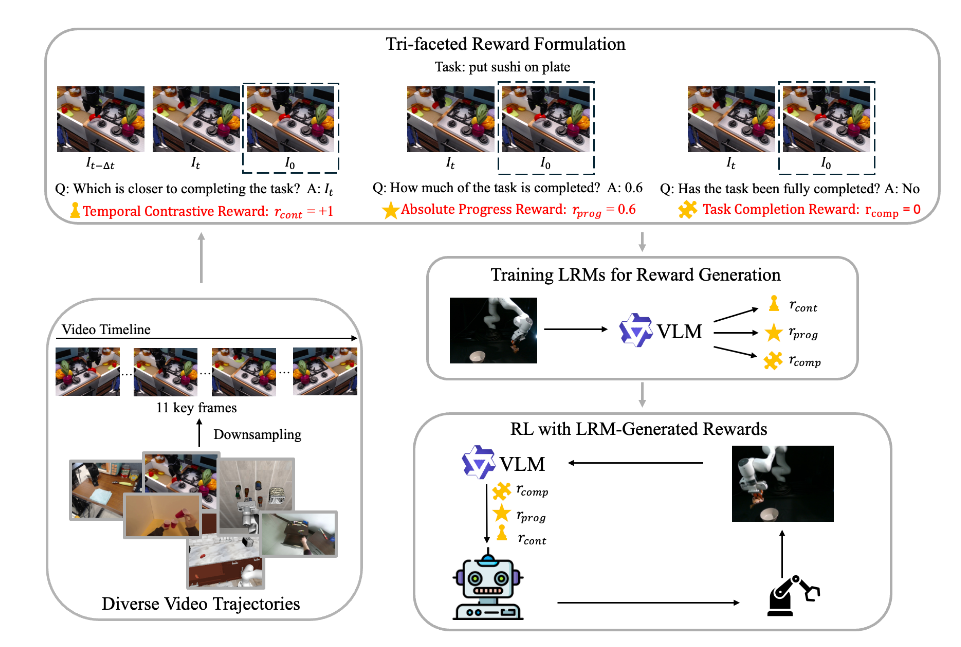
Reinforcement Learning (RL) has shown great potential in refining robotic manipulation policies, yet its efficacy remains strongly bottlenecked by the difficulty of designing generalizable reward functions. In this paper, we propose a framework for online policy refinement by adapting foundation VLMs into online reward generators. We develop a robust, scalable reward model based on a state-of-the-art VLM, trained on a large-scale, multi-source dataset encompassing real-world robot trajectories, human-object interactions, and diverse simulated environments. Unlike prior approaches that evaluate entire trajectories post-hoc, our method leverages the VLM to formulate a multifaceted reward signal comprising process, completion, and temporal contrastive rewards based on current visual observations. Initializing with a base policy trained via Imitation Learning (IL), we employ these VLM rewards to guide the model to correct sub-optimal behaviors in a closed-loop manner. We evaluate our framework on challenging long-horizon manipulation benchmarks requiring sequential execution and precise control. Crucially, our reward model operates in a purely zero-shot manner within these test environments. Experimental results demonstrate that our method significantly improves the success rate of the initial IL policy within just 30 RL iterations, demonstrating remarkable sample efficiency. This empirical evidence highlights that VLM-generated signals can provide reliable feedback to resolve execution errors, effectively eliminating the need for manual reward engineering and facilitating efficient online refinement for robot learning.
DreamPlan: Efficient Reinforcement Fine-Tuning of Vision-Language Planners via Video World Models
Emily Yue-Ting Jia, Weiduo Yuan, Tianheng Shi, Vitor Guizilini, Jiageng Mao, Yue Wang
arXiv 2026
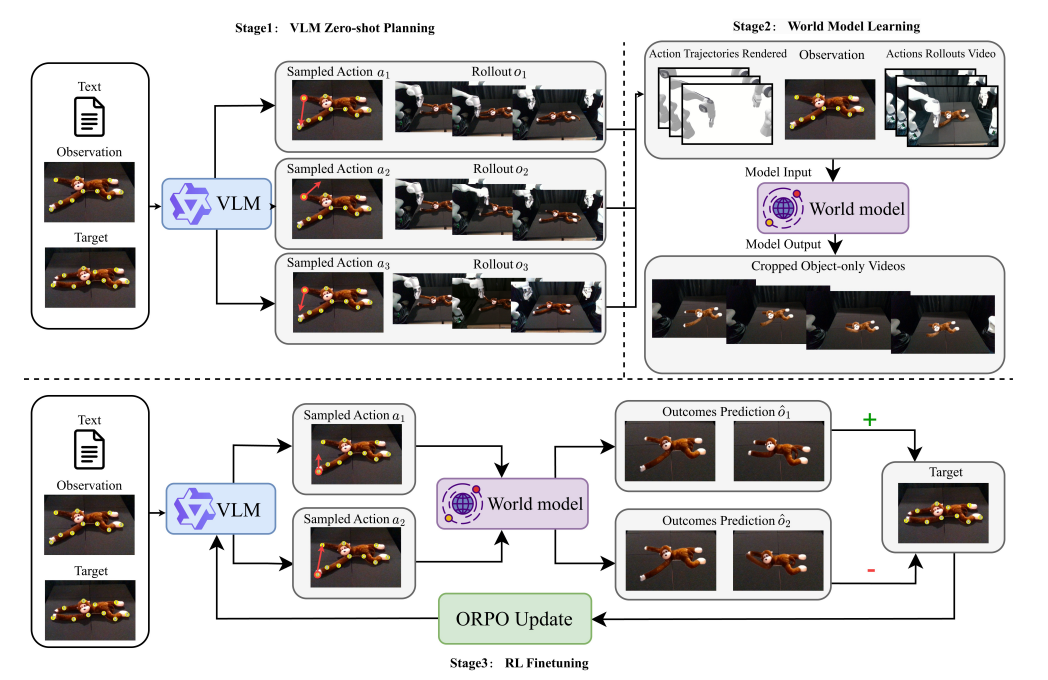
Robotic manipulation requires sophisticated commonsense reasoning, a capability naturally possessed by large-scale Vision-Language Models (VLMs). While VLMs show promise as zero-shot planners, their lack of grounded physical understanding often leads to compounding errors and low success rates when deployed in complex real-world environments, particularly for challenging tasks like deformable object manipulation. Although Reinforcement Learning (RL) can adapt these planners to specific task dynamics, directly fine-tuning VLMs via real-world interaction is prohibitively expensive, unsafe, and sample-inefficient. To overcome this bottleneck, we introduce DreamPlan, a novel framework for the reinforcement fine-tuning of VLM planners via video world models. Instead of relying on costly physical rollouts, DreamPlan first leverages the zero-shot VLM to collect exploratory interaction data. We demonstrate that this sub-optimal data is sufficient to train an action-conditioned video generation model, which implicitly captures complex real-world physics. Subsequently, the VLM planner is fine-tuned entirely within the "imagination" of this video world model using Odds Ratio Policy Optimization (ORPO). By utilizing these virtual rollouts, physical and task-specific knowledge is efficiently injected into the VLM. Our results indicate that DreamPlan bridges the gap between semantic reasoning and physical grounding, significantly improving manipulation success rates without the need for large-scale real-world data collection.
FuzzingRL: Reinforcement Fuzz-Testing for Revealing VLM Failures
Jiajun Xu, Jiageng Mao, Ang Qi, Weiduo Yuan, Alexander Romanus, Helen Xia, Vitor Campagnolo Guizilini, Yue Wang
arXiv 2026
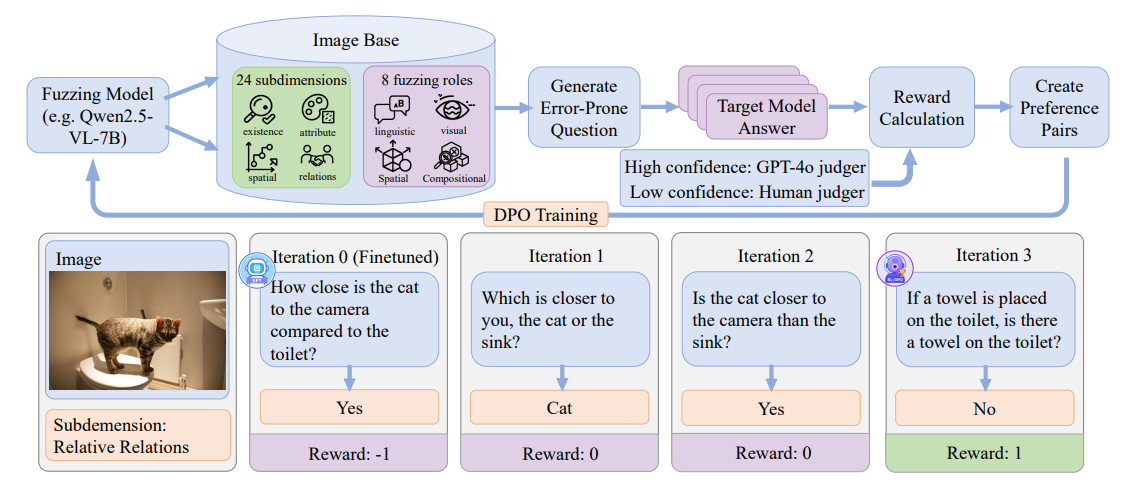
Vision Language Models (VLMs) are prone to errors, and identifying where these errors occur is critical for ensuring the reliability and safety of AI systems. In this paper, we propose an approach that automatically generates questions designed to deliberately induce incorrect responses from VLMs, thereby revealing their vulnerabilities. The core of this approach lies in fuzz testing and reinforcement finetuning: we transform a single input query into a large set of diverse variants through vision and language fuzzing. Based on the fuzzing outcomes, the question generator is further instructed by adversarial reinforcement fine-tuning to produce increasingly challenging queries that trigger model failures. With this approach, we can consistently drive down a target VLM answer accuracy -- for example, the accuracy of Qwen2.5-VL-32B on our generated questions drops from 86.58% to 65.53% in four RL iterations. Moreover, a fuzzing policy trained against a single target VLM transfers to multiple other VLMs, producing challenging queries that degrade their performance as well.

AnyView: Synthesizing Any Novel View in Dynamic Scenes
Basile Van Hoorick, Dian Chen, Shun Iwase, Pavel Tokmakov, Muhammad Zubair Irshad, Igor Vasiljevic, Swati Gupta, Fangzhou Cheng, Sergey Zakharov, Vitor Campagnolo Guizilini
arXiv 2026
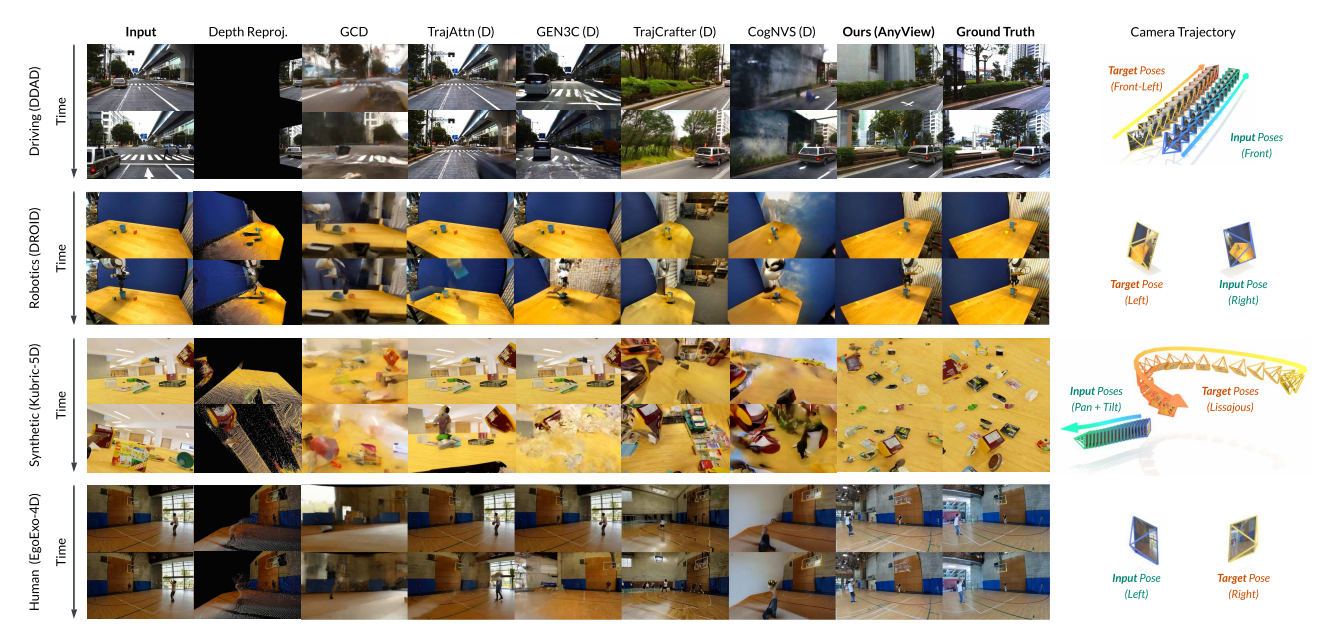
Modern generative video models excel at producing convincing, high-quality outputs, but struggle to maintain multi-view and spatiotemporal consistency in highly dynamic real-world environments. In this work, we introduce AnyView, a diffusion-based video generation framework for dynamic view synthesis with minimal inductive biases or geometric assumptions. We leverage multiple data sources with various levels of supervision, including monocular (2D), multi-view static (3D) and multi-view dynamic (4D) datasets, to train a generalist spatiotemporal implicit representation capable of producing zero-shot novel videos from arbitrary camera locations and trajectories. We evaluate AnyView on standard benchmarks, showing competitive results with the current state of the art, and propose AnyViewBench, a challenging new benchmark tailored towards extreme dynamic view synthesis in diverse real-world scenarios. In this more dramatic setting, we find that most baselines drastically degrade in performance, as they require significant overlap between viewpoints, while AnyView maintains the ability to produce realistic, plausible, and spatiotemporally consistent videos when prompted from any viewpoint.

Fiducial Exoskeletons: Image-Centric Robot State Estimation
Cameron Smith, Basile Van Hoorick, Vitor Guizilini, Yue Wang
arXiv 2026
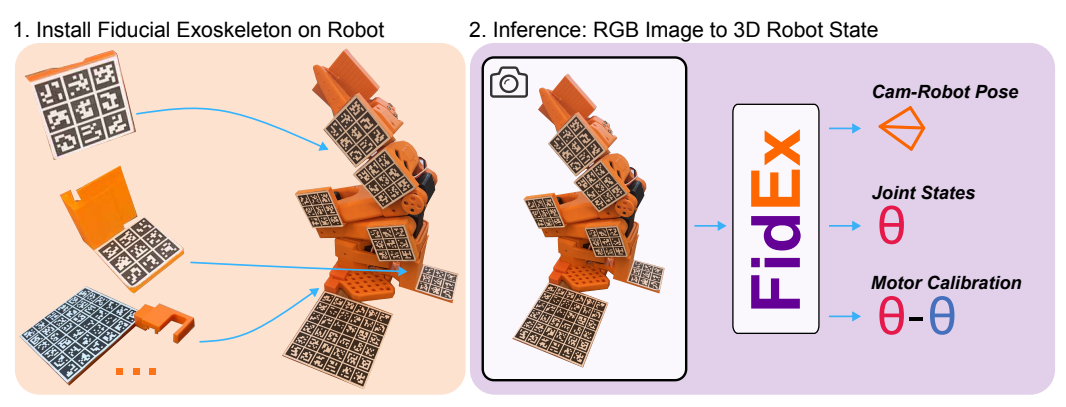
We introduce Fiducial Exoskeletons, an image-based reformulation of 3D robot state estimation that replaces cumbersome procedures and motor-centric pipelines with single-image inference. Traditional approaches - especially robot-camera extrinsic estimation - often rely on high-precision actuators and require time-consuming routines such as hand-eye calibration. In contrast, modern learning-based robot control is increasingly trained and deployed from RGB observations on lower-cost hardware. Our key insight is twofold. First, we cast robot state estimation as 6D pose estimation of each link from a single RGB image: the robot-camera base transform is obtained directly as the estimated base-link pose, and the joint state is recovered via a lightweight global optimization that enforces kinematic consistency with the observed link poses (optionally warm-started with encoder readings). Second, we make per-link 6D pose estimation robust and simple - even without learning - by introducing the fiducial exoskeleton: a lightweight 3D-printed mount with a fiducial marker on each link and known marker-link geometry. This design yields robust camera-robot extrinsics, per-link SE(3) poses, and joint-angle state from a single image, enabling robust state estimation even on unplugged robots. Demonstrated on a low-cost robot arm, fiducial exoskeletons substantially simplify setup while improving calibration, state accuracy, and downstream 3D control performance. We release code and printable hardware designs to enable further algorithm-hardware co-design.
AnchorDream: Repurposing Video Diffusion for Embodiment-Aware Robot Data Synthesis
Junjie Ye, Rong Xue, Basile Van Hoorick, Pavel Tokmakov, Muhammad Zubair Irshad, Yue Wang, Vitor Guizilini
ICRA 2026
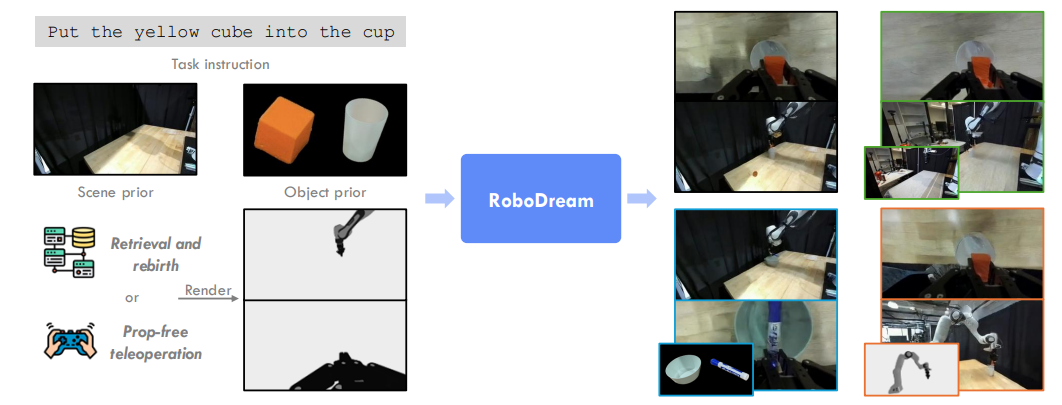
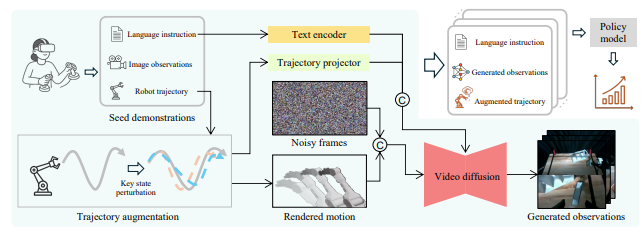
The collection of large-scale and diverse robot demonstrations remains a major bottleneck for imitation learning, as real-world data acquisition is costly and simulators offer limited diversity and fidelity with pronounced sim-to-real gaps. While generative models present an attractive solution, existing methods often alter only visual appearances without creating new behaviors, or suffer from embodiment inconsistencies that yield implausible motions. To address these limitations, we introduce AnchorDream, an embodiment-aware world model that repurposes pretrained video diffusion models for robot data synthesis. AnchorDream conditions the diffusion process on robot motion renderings, anchoring the embodiment to prevent hallucination while synthesizing objects and environments consistent with the robot`s kinematics. Starting from only a handful of human teleoperation demonstrations, our method scales them into large, diverse, high-quality datasets without requiring explicit environment modeling. Experiments show that the generated data leads to consistent improvements in downstream policy learning, with relative gains of 36.4% in simulator benchmarks and nearly double performance in real-world studies. These results suggest that grounding generative world models in robot motion provides a practical path toward scaling imitation learning.
NeuralRemaster: Phase-Preserving Diffusion for Structure-Aligned Generation
Yu Zeng, Charles Ochoa, Mingyuan Zhou, Vishal M. Patel, Vitor Guizilini, Rowan McAllister
arXiv 2025
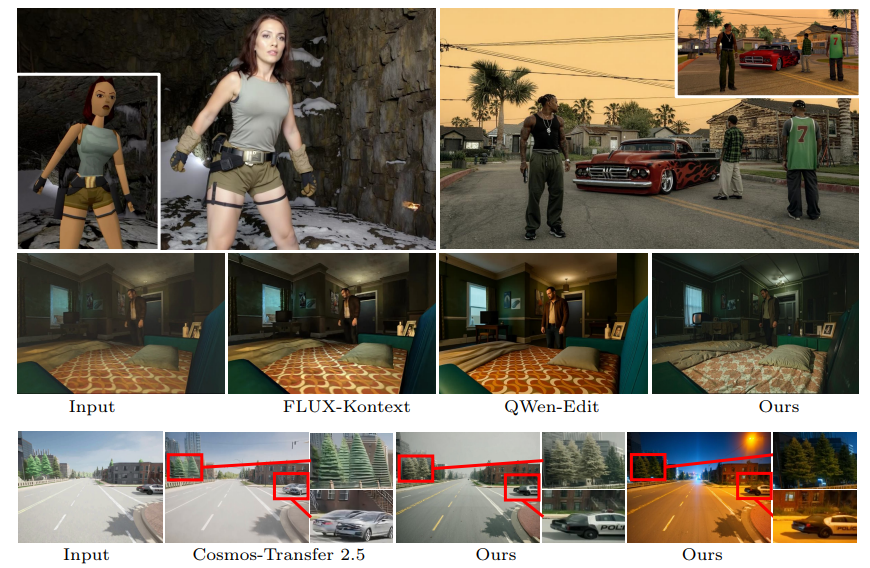
Standard diffusion corrupts data using Gaussian noise whose Fourier coefficients have random magnitudes and random phases. While effective for unconditional or text-to-image generation, corrupting phase components destroys spatial structure, making it ill-suited for tasks requiring geometric consistency, such as re-rendering, simulation enhancement, and image-to-image translation. We introduce Phase-Preserving Diffusion (\phi-PD), a model-agnostic reformulation of the diffusion process that preserves input phase while randomizing magnitude, enabling structure-aligned generation without architectural changes or additional parameters. We further propose Frequency-Selective Structured (FSS) noise, which provides continuous control over structural rigidity via a single frequency-cutoff parameter. \phi-PD adds no inference-time cost and is compatible with any diffusion model for images or videos. Across photorealistic and stylized re-rendering, as well as sim-to-real enhancement for driving planners, \phi-PD produces controllable, spatially aligned results. When applied to the CARLA simulator, \phi-PD significantly improves sim-to-real planner transfer performance. The method is complementary to existing conditioning approaches and broadly applicable to image-to-image and video-to-video generation.
Robot Learning from a Physical World Model
Jiageng Mao, Sicheng He, Hao-Ning Wu, Yang You, Shuyang Sun, Zhicheng Wang, Yanan Bao, Huizhong Chen, Leonidas Guibas, Vitor Guizilini, Howard Zhou, Yue Wang
ICRA 2026
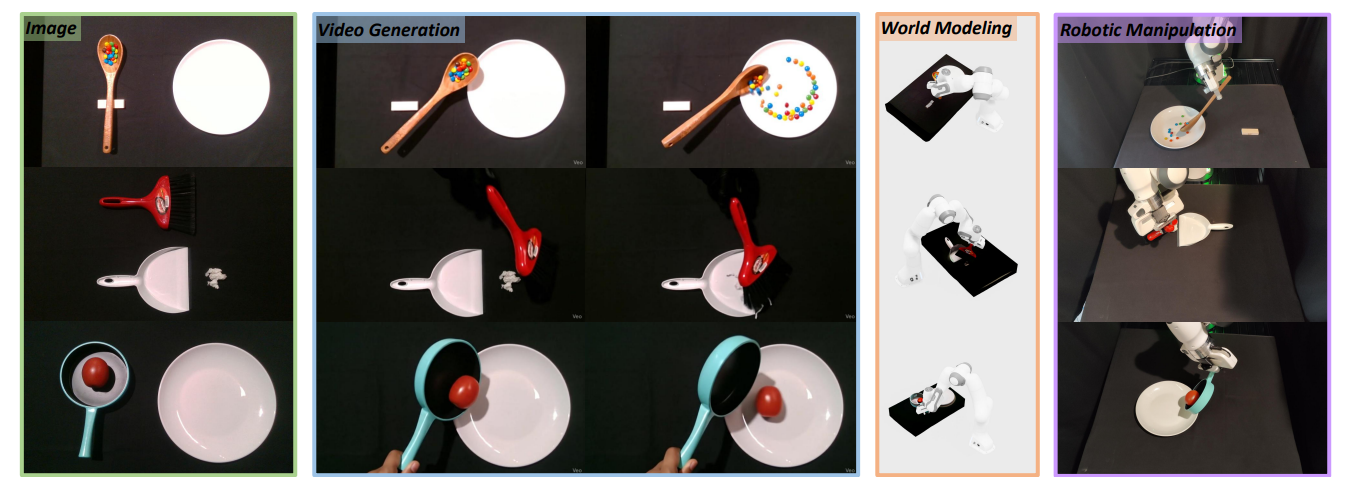
We introduce PhysWorld, a framework that enables robot learning from video generation through physical world modeling. Recent video generation models can synthesize photorealistic visual demonstrations from language commands and images, offering a powerful yet underexplored source of training signals for robotics. However, directly retargeting pixel motions from generated videos to robots neglects physics, often resulting in inaccurate manipulations. PhysWorld addresses this limitation by coupling video generation with physical world reconstruction. Given a single image and a task command, our method generates task-conditioned videos and reconstructs the underlying physical world from the videos, and the generated video motions are grounded into physically accurate actions through object-centric residual reinforcement learning with the physical world model. This synergy transforms implicit visual guidance into physically executable robotic trajectories, eliminating the need for real robot data collection and enabling zero-shot generalizable robotic manipulation. Experiments on diverse real-world tasks demonstrate that PhysWorld substantially improves manipulation accuracy compared to previous approaches.
Self-Supervised Geometry-Guided Initialization for Robust Monocular Visual Odometry
Takayuki Kanai, Igor Vasiljevic, Vitor Guizilini, Kazuhiro Shintani
IROS 2025
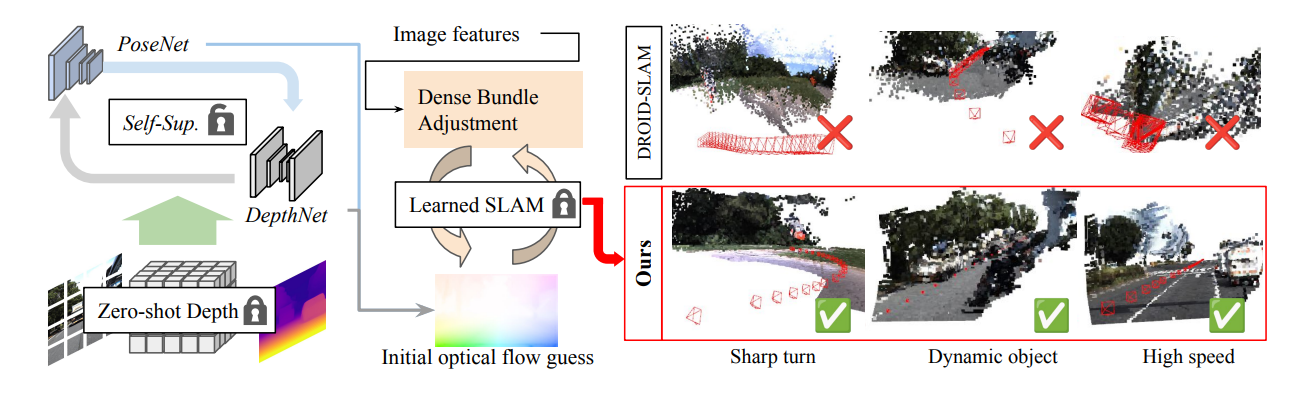
Monocular visual odometry is a key technology in various autonomous systems. Traditional feature-based methods suffer from failures due to poor lighting, insufficient texture, and large motions. In contrast, recent learning-based dense SLAM methods exploit iterative dense bundle adjustment to address such failure cases, and achieve robust and accurate localization in a wide variety of real environments, without depending on domain-specific supervision. However, despite its potential, the methods still struggle with scenarios involving large motion and object dynamics. In this study, we diagnose key weaknesses in a popular learning-based dense SLAM model (DROID-SLAM) by analyzing major failure cases on outdoor benchmarks and exposing various shortcomings of its optimization process. We then propose the use of self-supervised priors leveraging a frozen large-scale pre-trained monocular depth estimator to initialize the dense bundle adjustment process, leading to robust visual odometry without the need to fine-tune the SLAM backbone. Despite its simplicity, the proposed method demonstrates significant improvements on KITTI odometry, as well as the challenging DDAD benchmark.
Humanoid Everyday: A Comprehensive Robotic Dataset for Open-World Humanoid Manipulation
Zhenyu Zhao, Hongyi Jing, Xiawei Liu, Jiageng Mao, Abha Jha, Hanwen Yang, Rong Xue, Sergey Zakharov, Vitor Guizilini, Yue Wang
ICRA 2026
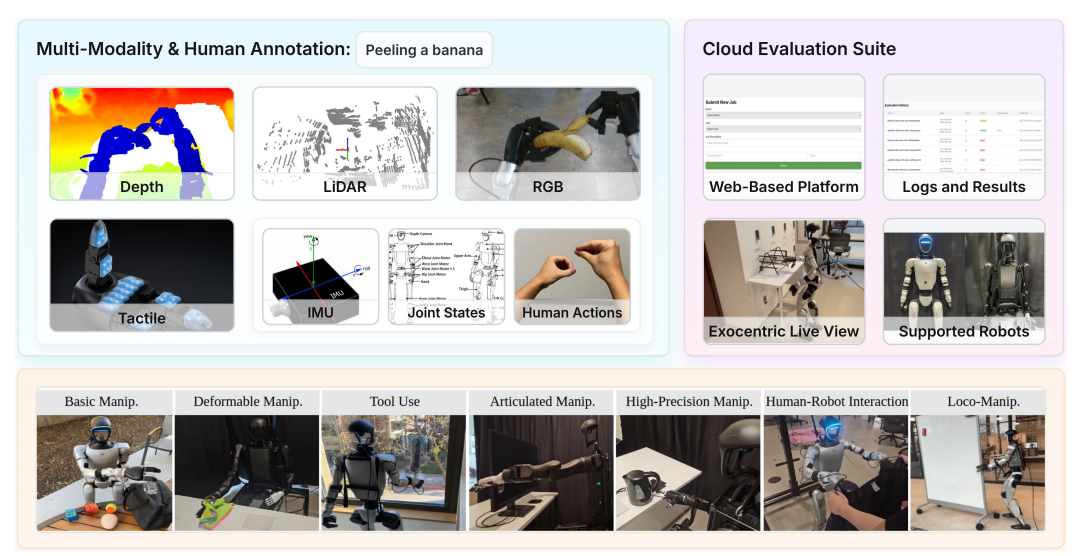
From loco-motion to dextrous manipulation, humanoid robots have made remarkable strides in demonstrating complex full-body capabilities. However, the majority of current robot learning datasets and benchmarks mainly focus on stationary robot arms, and the few existing humanoid datasets are either confined to fixed environments or limited in task diversity, often lacking human-humanoid interaction and lower-body locomotion. Moreover, there are a few standardized evaluation platforms for benchmarking learning-based policies on humanoid data. In this work, we present Humanoid Everyday, a large-scale and diverse humanoid manipulation dataset characterized by extensive task variety involving dextrous object manipulation, human-humanoid interaction, locomotion-integrated actions, and more. Leveraging a highly efficient human-supervised teleoperation pipeline, Humanoid Everyday aggregates high-quality multimodal sensory data, including RGB, depth, LiDAR, and tactile inputs, together with natural language annotations, comprising 10.3k trajectories and over 3 million frames of data across 260 tasks across 7 broad categories. In addition, we conduct an analysis of representative policy learning methods on our dataset, providing insights into their strengths and limitations across different task categories. For standardized evaluation, we introduce a cloud-based evaluation platform that allows researchers to seamlessly deploy their policies in our controlled setting and receive performance feedback. By releasing Humanoid Everyday along with our policy learning analysis and a standardized cloud-based evaluation platform, we intend to advance research in general-purpose humanoid manipulation and lay the groundwork for more capable and embodied robotic agents in real-world scenarios.
Robot Learning from Any Images
Siheng Zhao, Jiageng Mao, Wei Chow, Zeyu Shangguan, Tianheng Shi, Rong Xue, Yuxi Zheng, Yijia Weng, Yang You, Daniel Seita, Leonidas Guibas, Sergey Zakharov, Vitor Guizilini, Yue Wang
CoRL 2025
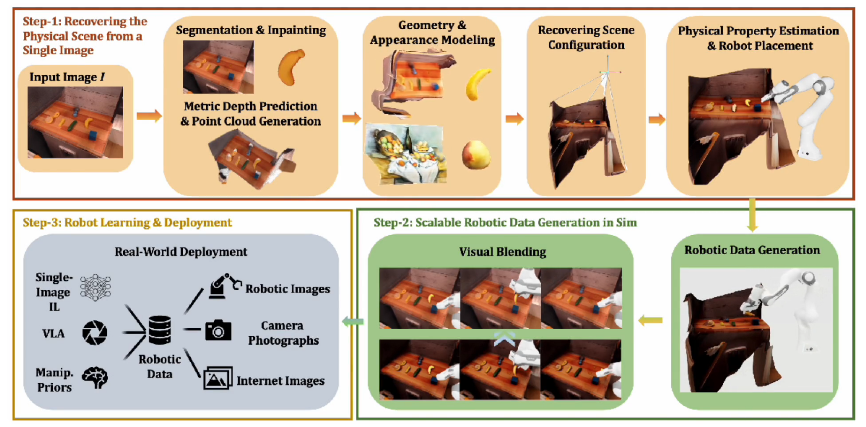
We introduce RoLA, a framework that transforms any in-the-wild image into an interactive, physics-enabled robotic environment. Unlike previous methods, RoLA operates directly on a single image without requiring additional hardware or digital assets. Our framework democratizes robotic data generation by producing massive visuomotor robotic demonstrations within minutes from a wide range of image sources, including camera captures, robotic datasets, and Internet images. At its core, our approach combines a novel method for single-view physical scene recovery with an efficient visual blending strategy for photorealistic data collection. We demonstrate RoLA`s versatility across applications like scalable robotic data generation and augmentation, robot learning from Internet images, and single-image real-to-sim-to-real systems for manipulators and humanoids.
Do You Know Where Your Camera Is? View-Invariant Policy Learning with Camera Conditioning
Tianchong Jiang, Jingtian Ji, Xiangshan Tan, Jiading Fang, Anand Bhattad, Vitor Guizilini, Matthew R. Walter
ICRA 2026 (Best Paper Award)
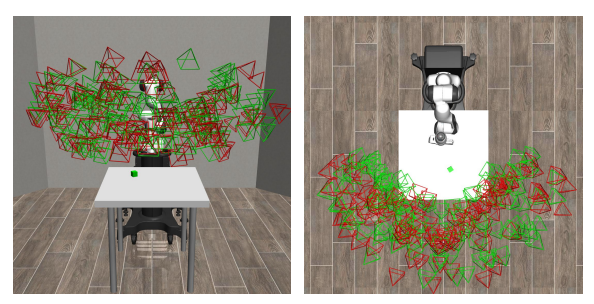
We study view-invariant imitation learning by explicitly conditioning policies on camera extrinsics. Using Plucker embeddings of per-pixel rays, we show that conditioning on extrinsics significantly improves generalization across viewpoints for standard behavior cloning policies, including ACT, Diffusion Policy, and SmolVLA. To evaluate policy robustness under realistic viewpoint shifts, we introduce six manipulation tasks in RoboSuite and ManiSkill that pair "fixed" and "randomized" scene variants, decoupling background cues from camera pose. Our analysis reveals that policies without extrinsics often infer camera pose using visual cues from static backgrounds in fixed scenes; this shortcut collapses when workspace geometry or camera placement shifts. Conditioning on extrinsics restores performance and yields robust RGB-only control without depth.
Learning from Massive Human Videos for Universal Humanoid Pose Control
Jiageng Mao, Siheng Zhao, Siqi Song, Tianheng Shi, Junjie Ye, Mingtong Zhang, Haoran Geng, Jitendra Malik, Vitor Guizilini, Yue Wang
Humanoids 2025 (oral presentation)
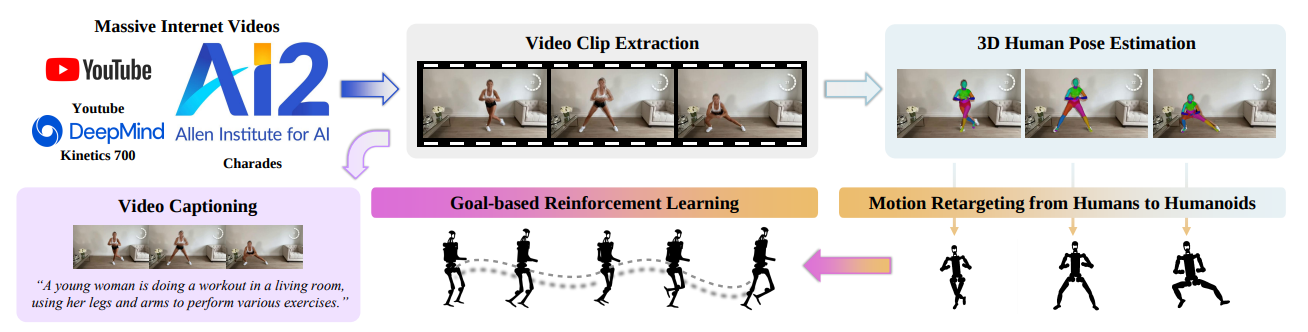
Scalable learning of humanoid robots is crucial for their deployment in real-world applications. While traditional approaches primarily rely on reinforcement learning or teleoperation to achieve whole-body control, they are often limited by the diversity of simulated environments and the high costs of demonstration collection. In contrast, human videos are ubiquitous and present an untapped source of semantic and motion information that could significantly enhance the generalization capabilities of humanoid robots. This paper introduces Humanoid-X, a large-scale dataset of over 20 million humanoid robot poses with corresponding text-based motion descriptions, designed to leverage this abundant data. Humanoid-X is curated through a comprehensive pipeline: data mining from the Internet, video caption generation, motion retargeting of humans to humanoid robots, and policy learning for real-world deployment. With Humanoid-X, we further train a large humanoid model, UH-1, which takes text instructions as input and outputs corresponding actions to control a humanoid robot. Extensive simulated and real-world experiments validate that our scalable training approach leads to superior generalization in text-based humanoid control, marking a significant step toward adaptable, real-world-ready humanoid robots.
PhysBench: Benchmarking and Enhancing Vision-Language Models for Physical World Understanding
Wei Chow, Jiageng Mao, Boyi Li, Daniel Seita, Vitor Guizilini, Yue Wang
ICLR 2025
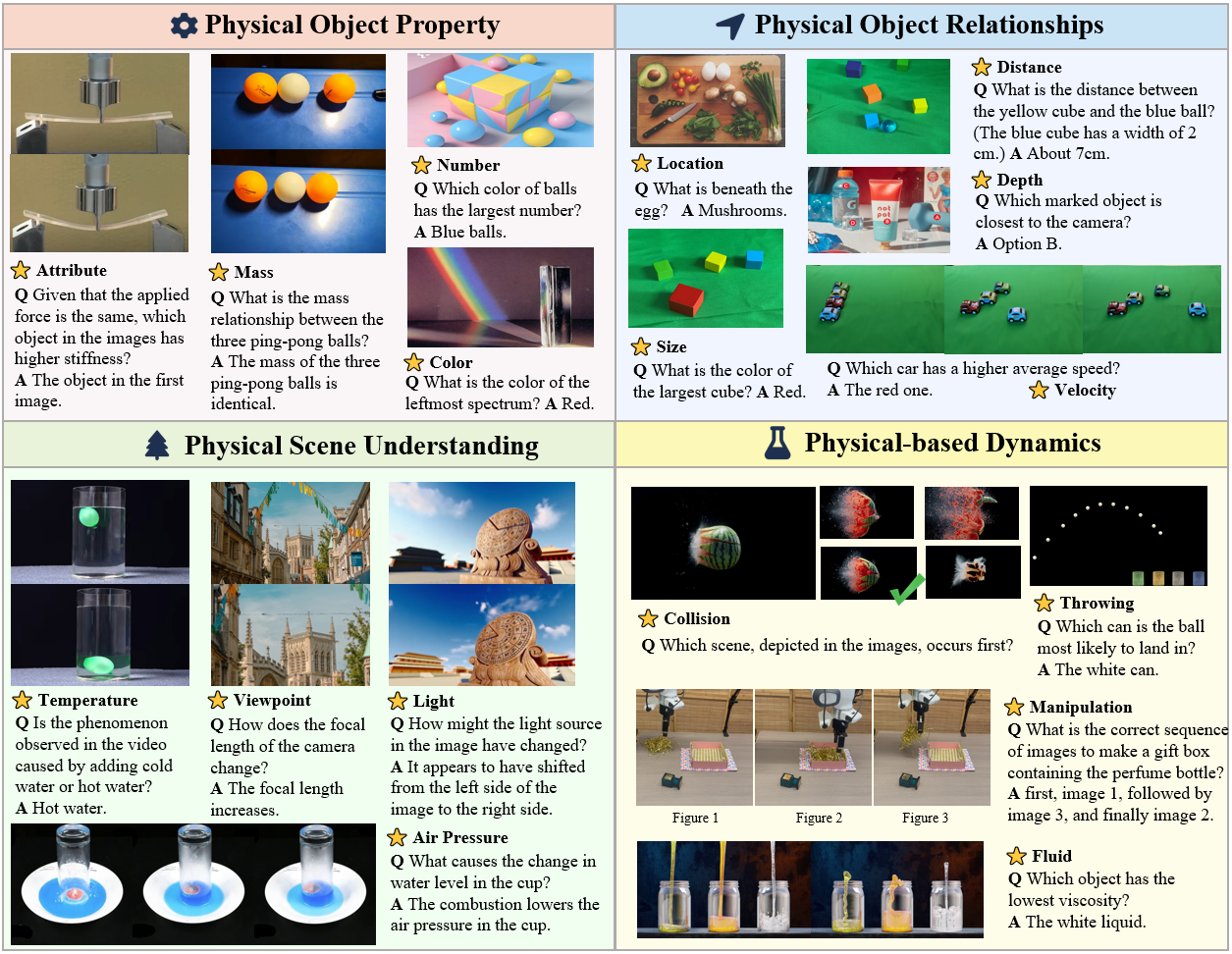
Understanding the physical world is a fundamental challenge in embodied AI, critical for enabling agents to perform complex tasks and operate safely in real-world environments. While Vision-Language Models (VLMs) have shown great promise in reasoning and task planning for embodied agents, their ability to comprehend physical phenomena remains extremely limited. To close this gap, we introduce PhysBench, a comprehensive benchmark designed to evaluate VLMs physical world understanding capability across a diverse set of tasks. PhysBench contains 10,002 entries of interleaved video-image-text data, categorized into four major domains: physical object properties, physical object relationships, physical scene understanding, and physics-based dynamics, further divided into 19 subclasses and 8 distinct capability dimensions. Our extensive experiments, conducted on 75 representative VLMs, reveal that while these models excel in common-sense reasoning, they struggle with understanding the physical world -- likely due to the absence of physical knowledge in their training data and the lack of embedded physical priors. To tackle the shortfall, we introduce PhysAgent, a novel framework that combines the generalization strengths of VLMs with the specialized expertise of vision models, significantly enhancing VLMs physical understanding across a variety of tasks, including an 18.4\% improvement on GPT-4o. Furthermore, our results demonstrate that enhancing VLMs physical world understanding capabilities can help embodied agents such as MOKA. We believe that PhysBench and PhysAgent offer valuable insights and contribute to bridging the gap between VLMs and physical world understanding.
SIRE: SE(3) Intrinsic Rigidity Embeddings
Cameron Smith, Basile Van Hoorick, Vitor Guizilini, Yue Wang
arXiv 2025
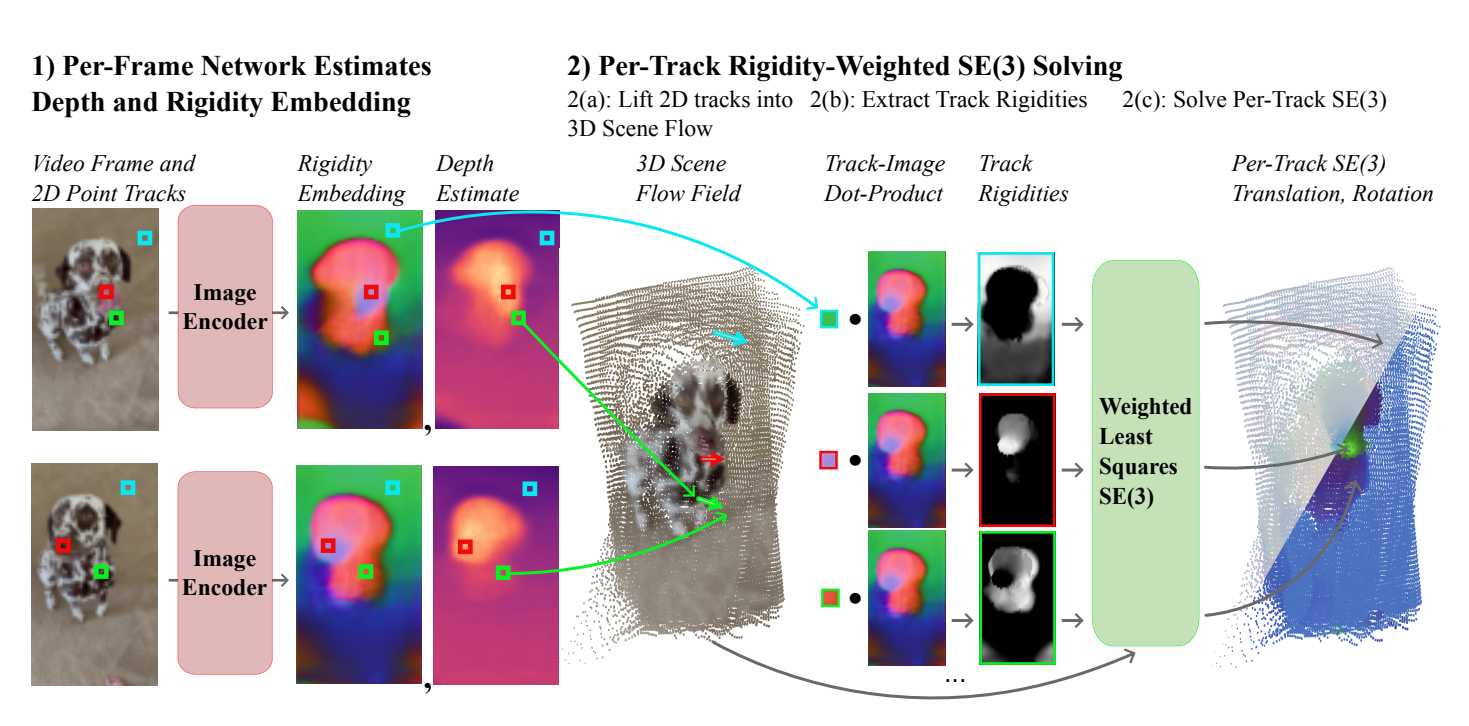
Motion serves as a powerful cue for scene perception and understanding by separating independently moving surfaces and organizing the physical world into distinct entities. We introduce SIRE, a self-supervised method for motion discovery of objects and dynamic scene reconstruction from casual scenes by learning intrinsic rigidity embeddings from videos. Our method trains an image encoder to estimate scene rigidity and geometry, supervised by a simple 4D reconstruction loss: a least-squares solver uses the estimated geometry and rigidity to lift 2D point track trajectories into SE(3) tracks, which are simply re-projected back to 2D and compared against the original 2D trajectories for supervision. Crucially, our framework is fully end-to-end differentiable and can be optimized either on video datasets to learn generalizable image priors, or even on a single video to capture scene-specific structure - highlighting strong data efficiency. We demonstrate the effectiveness of our rigidity embeddings and geometry across multiple settings, including downstream object segmentation, SE(3) rigid motion estimation, and self-supervised depth estimation. Our findings suggest that SIRE can learn strong geometry and motion rigidity priors from video data, with minimal supervision.
ZeroGrasp: Zero-Shot Shape Reconstruction Enabled Robotic Grasping
Shun Iwase, Zubair Irshad, Katherine Liu, Vitor Guizilini, Robert Lee, Takuya Ikeda, Ayako Amma, Koichi Nishiwaki, Kris Kitani, Rares Ambrus, Sergey Zakharov
CVPR 2025
Robotic grasping is a cornerstone capability of embodied systems. Many methods directly output grasps from partial information without modeling the geometry of the scene, leading to suboptimal motion and even collisions. To address these issues, we introduce ZeroGrasp, a novel framework that simultaneously performs 3D reconstruction and grasp pose prediction in near real-time. A key insight of our method is that occlusion reasoning and modeling the spatial relationships between objects is beneficial for both accurate reconstruction and grasping. We couple our method with a novel large-scale synthetic dataset, which comprises 1M photo-realistic images, high-resolution 3D reconstructions and 11.3B physically-valid grasp pose annotations for 12K objects from the Objaverse-LVIS dataset. We evaluate ZeroGrasp on the GraspNet-1B benchmark as well as through real-world robot experiments. ZeroGrasp achieves state-of-the-art performance and generalizes to novel real-world objects by leveraging synthetic data.
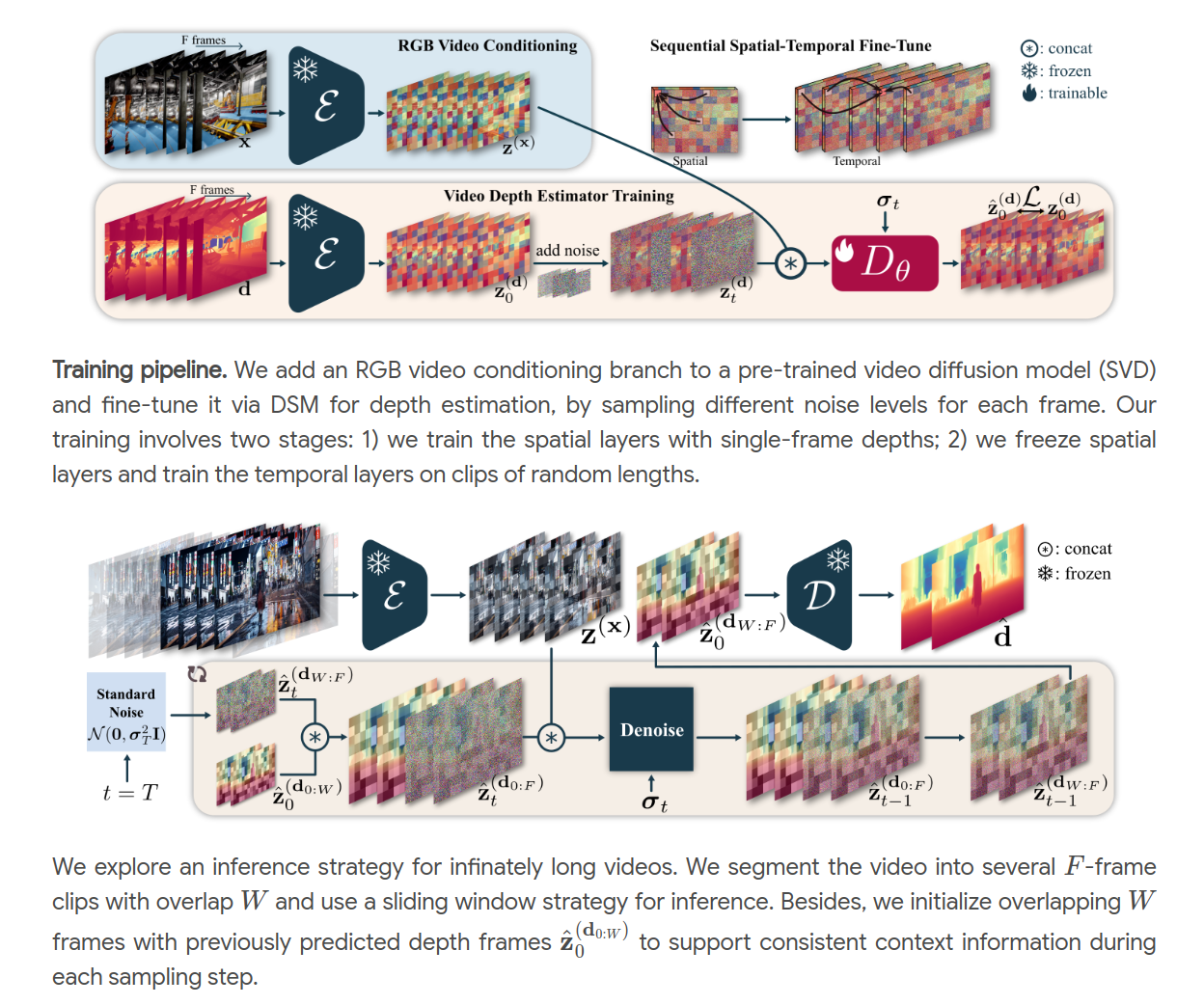
Learning Temporally Consistent Video Depth from Video Diffusion Priors
Jiahao Shao, Yuanbo Yang, Hongyu Zhou, Youmin Zhang, Yujun Shen, Vitor Guizilini, Yue Wang, Matteo Poggi, Yiyi Liao
CVPR 2025
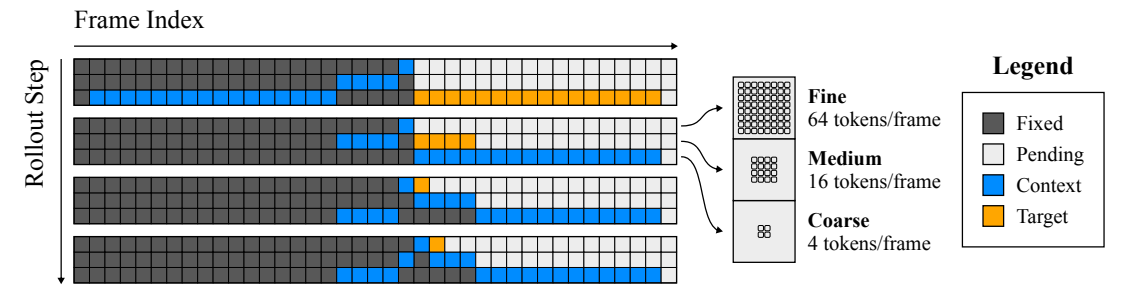
This work addresses the challenge of streamed video depth estimation, which expects not only per-frame accuracy but, more importantly, cross-frame consistency. We argue that sharing contextual information between frames or clips is pivotal in fostering temporal consistency. Thus, instead of directly developing a depth estimator from scratch, we reformulate this predictive task into a conditional generation problem to provide contextual information within a clip and across clips. Specifically, we propose a consistent context-aware training and inference strategy for arbitrarily long videos to provide cross-clip context. We sample independent noise levels for each frame within a clip during training while using a sliding window strategy and initializing overlapping frames with previously predicted frames without adding noise. Moreover, we design an effective training strategy to provide context within a clip. Extensive experimental results validate our design choices and demonstrate the superiority of our approach, dubbed ChronoDepth.
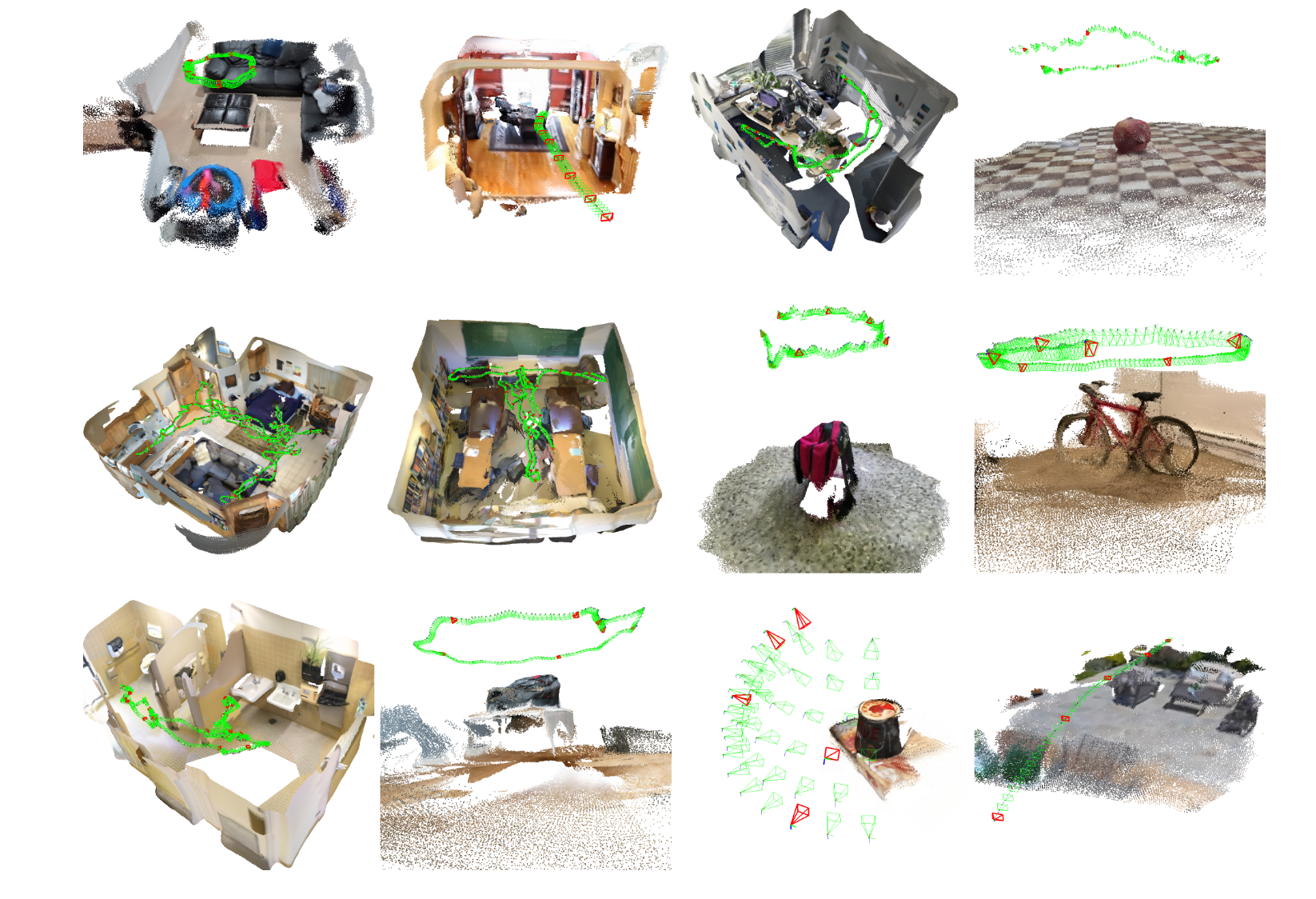
Zero-Shot Novel View and Depth Synthesis with Multi-View Geometric Diffusion
Vitor Guizilini, Muhammad Zubair Irshad, Dian Chen, Greg Shakhnarovich, Rares Ambrus
CVPR 2025
Current methods for 3D scene reconstruction from sparse posed images employ intermediate 3D representations such as neural fields, voxel grids, or 3D Gaussians, to achieve multi-view consistent scene appearance and geometry. In this paper we introduce MVGD, a diffusion-based architecture capable of direct pixel-level generation of images and depth maps from novel viewpoints, given an arbitrary number of input views. Our method uses raymap conditioning to both augment visual features with spatial information from different viewpoints, as well as to guide the generation of images and depth maps from novel views. A key aspect of our approach is the multi-task generation of images and depth maps, using learnable task embeddings to guide the diffusion process towards specific modalities. We train this model on a collection of more than 60 million multi-view samples from publicly available datasets, and propose techniques to enable efficient and consistent learning in such diverse conditions. We also propose a novel strategy that enables the efficient training of larger models by incrementally fine-tuning smaller ones, with promising scaling behavior. Through extensive experiments, we report state-of-the-art results in multiple novel view synthesis benchmarks, as well as multi-view stereo and video depth estimation.
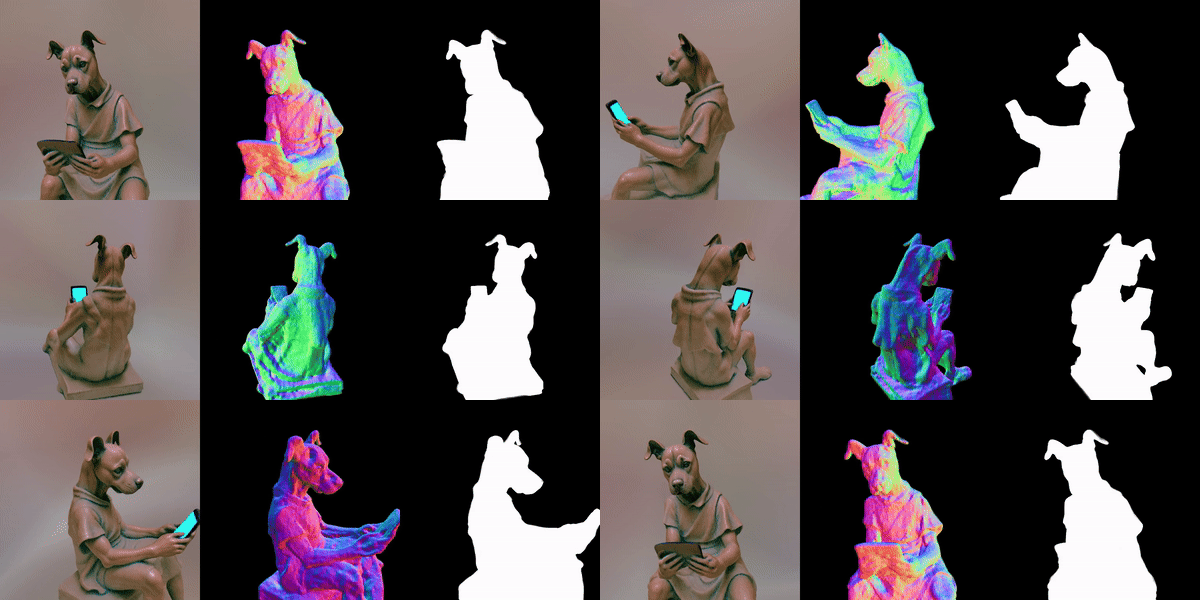
Score Distillation via Reparametrized DDIM
Artem Lukoianov, Haitz Borde, Kristjan Greenewald, Vitor Guizilini, Timur Bagautdinov, Vincent Sitzmann, Justin Solomon
NeurIPS 2024
While 2D diffusion models generate realistic, high-detail images, 3D shape generation methods like Score Distillation Sampling (SDS) built on these 2D diffusion models produce cartoon-like, over-smoothed shapes. To help explain this discrepancy, we show that the image guidance used in Score Distillation can be understood as the velocity field of a 2D denoising generative process, up to the choice of a noise term. In particular, after a change of variables, SDS resembles a high-variance version of Denoising Diffusion Implicit Models (DDIM) with a differently-sampled noise term: SDS introduces noise i.i.d. randomly at each step, while DDIM infers it from the previous noise predictions. This excessive variance can lead to over-smoothing and unrealistic outputs. We show that a better noise approximation can be recovered by inverting DDIM in each SDS update step. This modification makes SDS generative process for 2D images almost identical to DDIM. In 3D, it removes over-smoothing, preserves higher-frequency detail, and brings the generation quality closer to that of 2D samplers. Experimentally, our method achieves better or similar 3D generation quality compared to other state-of-the-art Score Distillation methods, all without training additional neural networks or multi-view supervision, and providing useful insights into relationship between 2D and 3D asset generation with diffusion models.
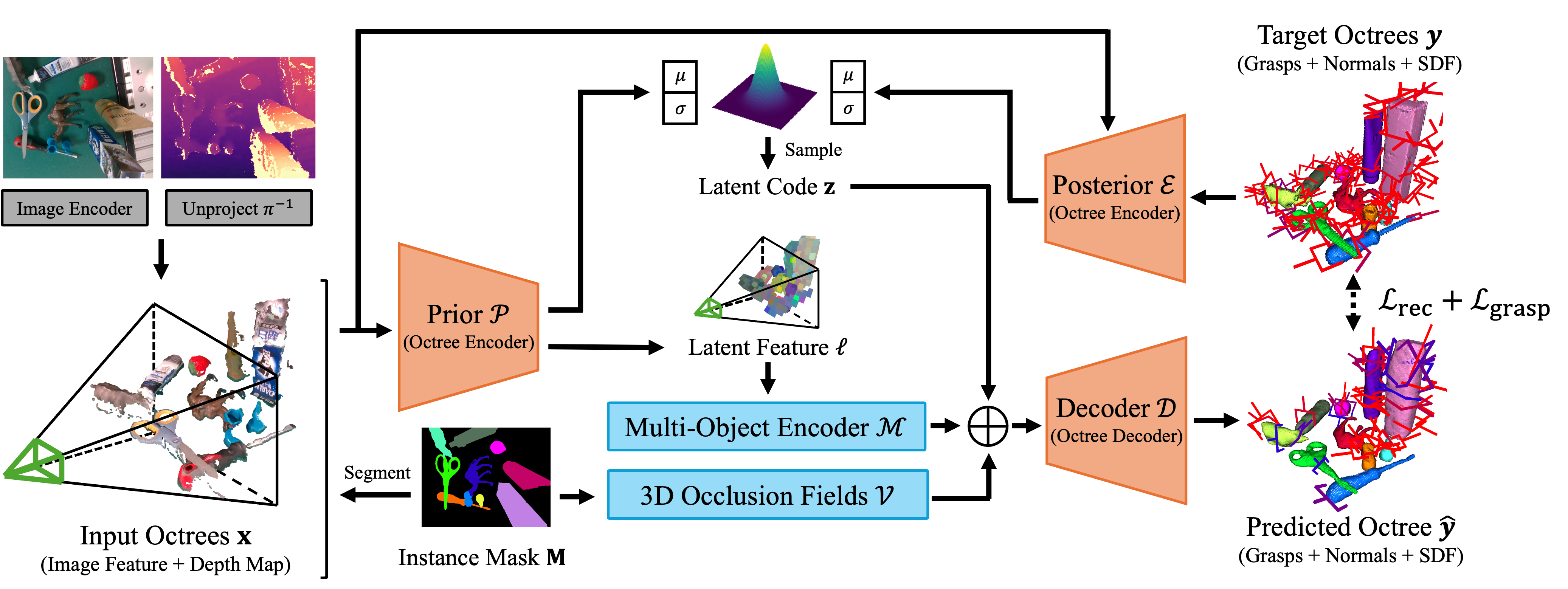
Zero-Shot Multi-Object Shape Completion
Shun Iwase, Katherine Liu, Vitor Guizilini, Adrien Gaidon, Kris Kitani, Rares Ambrus, Sergey Zakharov
ECCV 2024
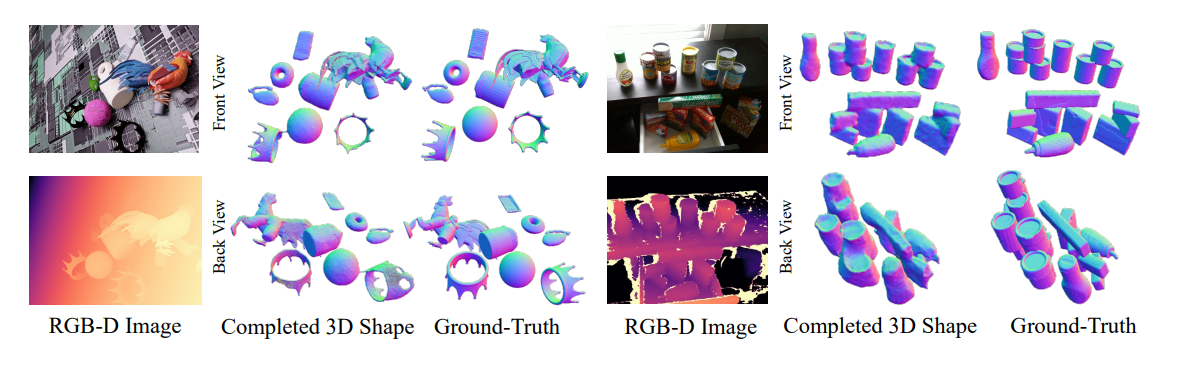
We present a 3D shape completion method that recovers the complete geometry of multiple objects in complex scenes from a single RGB-D image. Despite notable advancements in single object 3D shape completion, high-quality reconstructions in highly cluttered real-world multi-object scenes remains a challenge. To address this issue, we propose OctMAE, an architecture that leverages an Octree U-Net and a latent 3D MAE to achieve high-quality and near real-time multi-object shape completion through both local and global geometric reasoning. Because a naive 3D MAE can be computationally intractable and memory intensive even in the latent space, we introduce a novel occlusion masking strategy and adopt 3D rotary embeddings, which significantly improves the runtime and shape completion quality. To generalize to a wide range of objects in diverse scenes, we create a large-scale photorealistic dataset, featuring a diverse set of 12K 3D object models from the Objaverse dataset which are rendered in multi-object scenes with physics-based positioning. Our method outperforms the current state-of-the-art on both synthetic and real-world datasets and demonstrates a strong zero-shot capability.
Towards Realistic Scene Generation with LiDAR Diffusion Models
Haoxi Ran, Vitor Guizilini, Yue Wang
CVPR 2024
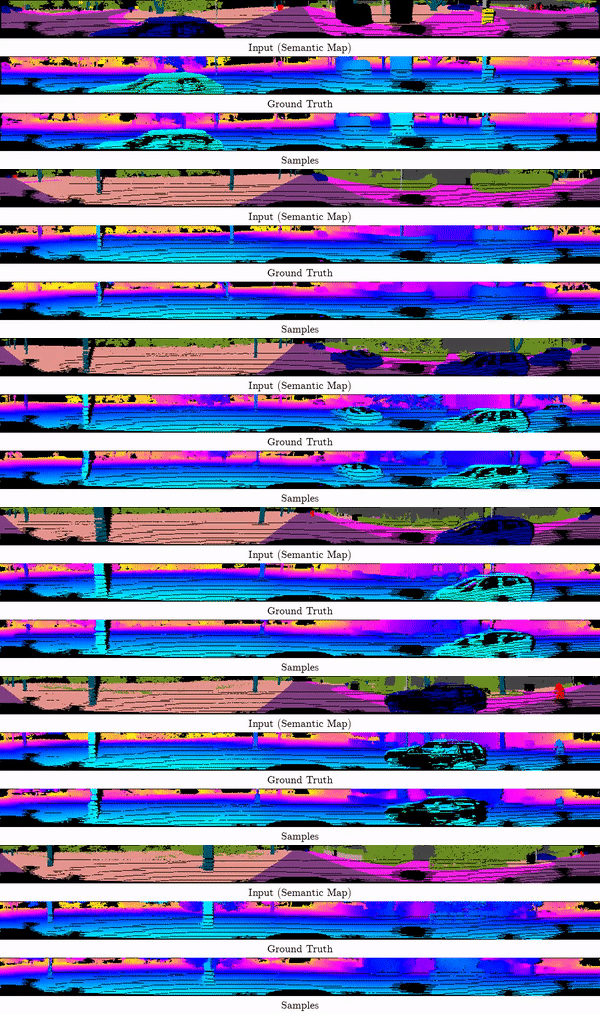
Diffusion models (DMs) excel in photo-realistic image synthesis, but their adaptation to LiDAR scene generation poses a substantial hurdle. This is primarily because DMs operating in the point space struggle to preserve the curve-like patterns and 3D geometry of LiDAR scenes, which consumes much of their representation power. In this paper, we propose LiDAR Diffusion Models (LiDMs) to generate LiDAR-realistic scenes from a latent space tailored to capture the realism of LiDAR scenes by incorporating geometric priors into the learning pipeline. Our method targets three major desiderata: pattern realism, geometry realism, and object realism. Specifically, we introduce curve-wise compression to simulate real-world LiDAR patterns, point-wise coordinate supervision to learn scene geometry, and patch-wise encoding for a full 3D object context. With these three core designs, our method achieves competitive performance on unconditional LiDAR generation in 64-beam scenario and state of the art on conditional LiDAR generation, while maintaining high efficiency compared to point-based DMs (up to 107× faster). Furthermore, by compressing LiDAR scenes into a latent space, we enable the controllability of DMs with various conditions such as semantic maps, camera views, and text prompts.
Robust Self-Supervised Extrinsic Self-Calibration
Takayuki Kanai, Igor Vasiljevic, Vitor Guizilini, Adrien Gaidon, Rares Ambrus
IROS 2023
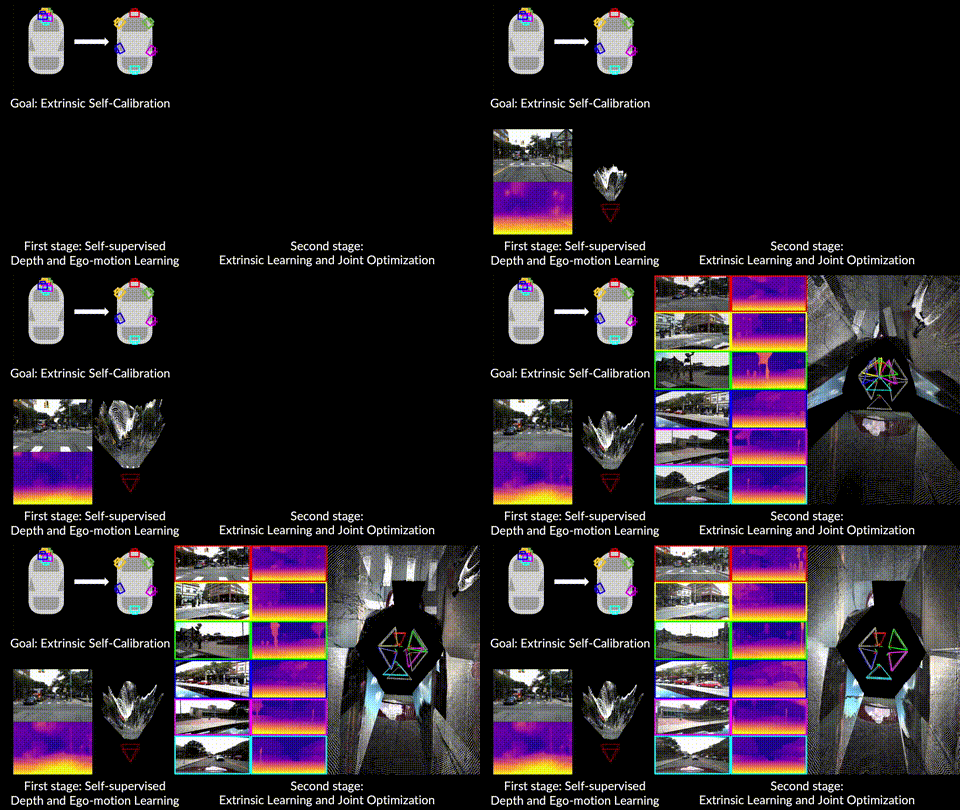
Autonomous vehicles and robots need to operate over a wide variety of scenarios in order to complete tasks efficiently and safely. Multi-camera self-supervised monocular depth estimation from videos is a promising way to reason about the environment, as it generates metrically scaled geometric predictions from visual data without requiring additional sensors. However, most works assume well-calibrated extrinsics to fully leverage this multi-camera setup, even though accurate and efficient calibration is still a challenging problem. In this work, we introduce a novel method for extrinsic calibration that builds upon the principles of self-supervised monocular depth and ego-motion learning. Our proposed curriculum learning strategy uses monocular depth and pose estimators with velocity supervision to estimate extrinsics, and then jointly learns extrinsic calibration along with depth and pose for a set of overlapping cameras rigidly attached to a moving vehicle. Experiments on a benchmark multi-camera dataset (DDAD) demonstrate that our method enables self-calibration in various scenes robustly and efficiently compared to a traditional vision-based pose estimation pipeline. Furthermore, we demonstrate the benefits of extrinsics self-calibration as a way to improve depth prediction via joint optimization.
NeO 360: Neural Fields for Sparse View Synthesis of Outdoor Scenes
Muhammad Zubair Irshad, Sergey Zakharov, Katherine Liu, Vitor Guizilini, Thomas Kollar, Adrien Gaidon, Zsolt Kira, Rares Ambrus
ICCV 2023
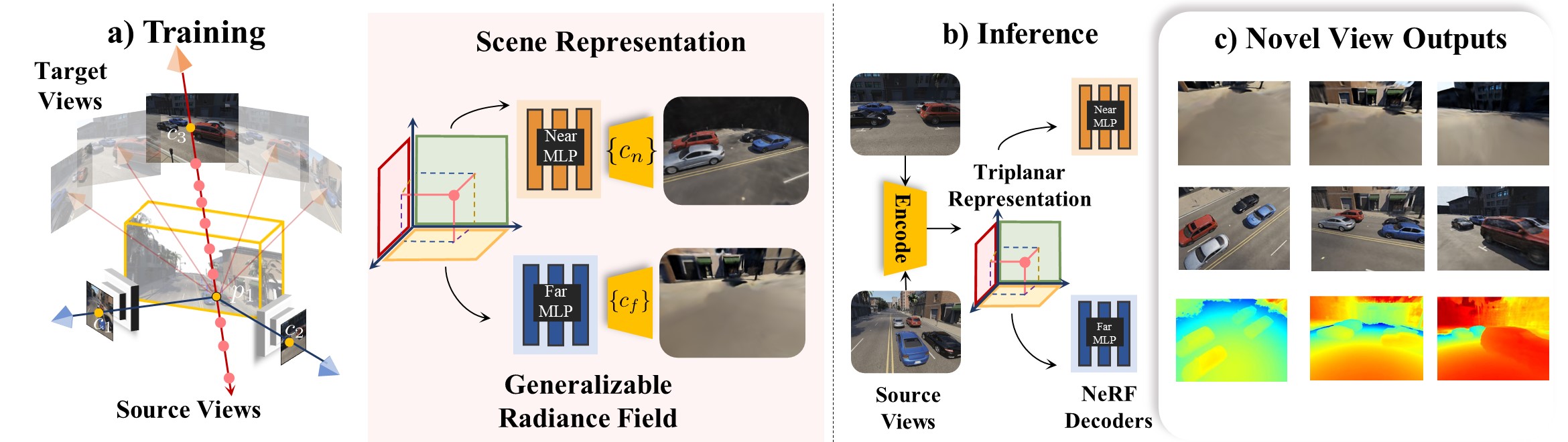
Recent implicit neural representations have shown great results for novel view synthesis. However, existing methods require expensive per-scene optimization from many views hence limiting their application to real-world unbounded urban settings where the objects of interest or backgrounds are observed from very few views. To mitigate this challenge, we introduce a new approach called NeO 360, Neural fields for sparse view synthesis of outdoor scenes. NeO 360 is a generalizable method that reconstructs 360° scenes from a single or a few posed RGB images. The essence of our approach is in capturing the distribution of complex real-world outdoor 3D scenes and using a hybrid image-conditional triplanar representation that can be queried from any world point. Our representation combines the best of both voxel-based and bird`s-eye-view (BEV) representations and is more effective and expressive than each. NeO 360`s representation allows us to learn from a large collection of unbounded 3D scenes while offering generalizability to new views and novel scenes from as few as a single image during inference. We demonstrate our approach on the proposed challenging 360° unbounded dataset, called NeRDS 360, and show that NeO 360 outperforms state-of-the-art generalizable methods for novel view synthesis while also offering editing and composition capabilities.
Depth Is All You Need for Monocular 3D Detection
Dennis Park, Jie Li, Dian Chen, Vitor Guizilini, Adrien Gaidon
ICRA 2023
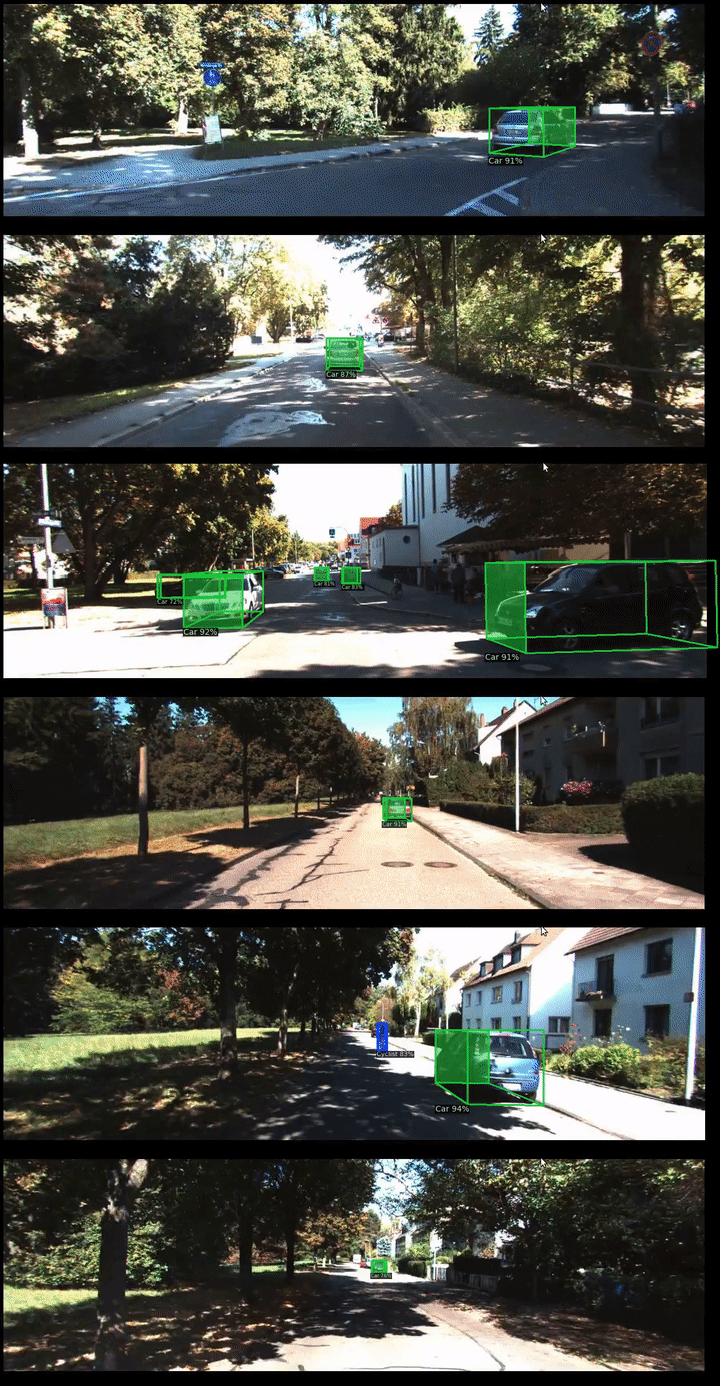
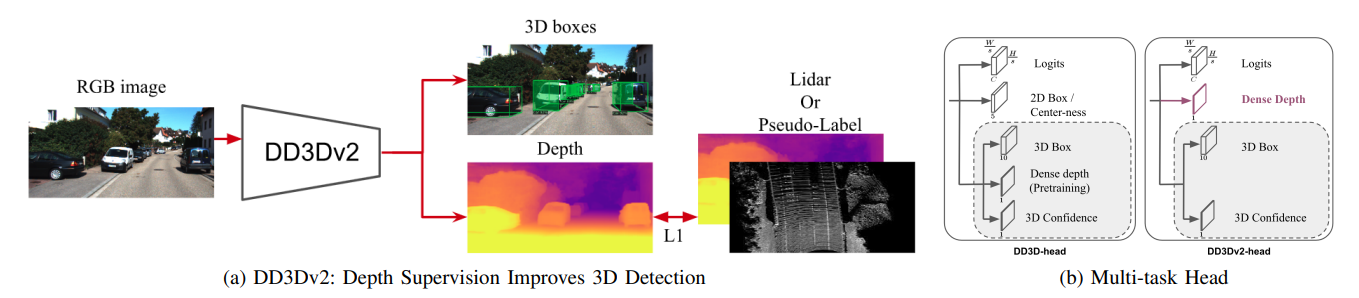
A key contributor to recent progress in 3D detection from single images is monocular depth estimation. Existing methods focus on how to leverage depth explicitly, by generating pseudo-pointclouds or providing attention cues for image features. More recent works leverage depth prediction as a pretraining task and fine-tune the depth representation while training it for 3D detection. However, the adaptation is insufficient and is limited in scale by manual labels. In this work, we propose to further align depth representation with the target domain in unsupervised fashions. Our methods leverage commonly available LiDAR or RGB videos during training time to fine-tune the depth representation, which leads to improved 3D detectors. Especially when using RGB videos, we show that our two-stage training by first generating pseudo-depth labels is critical because of the inconsistency in loss distribution between the two tasks. With either type of reference data, our multi-task learning approach improves over the state of the art on both KITTI and NuScenes, while matching the test-time complexity of its single task sub-network.
NeRFuser: Large-Scale Scene Representation by NeRF Fusion
Jiading Fang, Shengjie Lin, Igor Vasiljevic, Vitor Guizilini, Rares Ambrus, Adrien Gaidon, Gregory Shakhnarovich, Matthew R. Walter
ISRR 2024
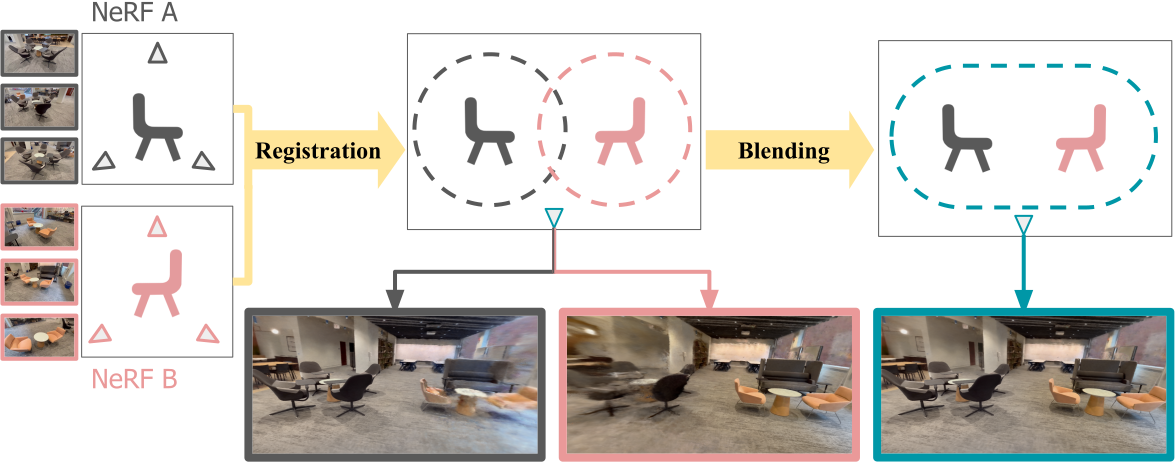
A practical benefit of implicit visual representations like Neural Radiance Fields (NeRFs) is their memory efficiency: large scenes can be efficiently stored and shared as small neural nets instead of collections of images. However, operating on these implicit visual data structures requires extending classical image-based vision techniques (e.g., registration, blending) from image sets to neural fields. Towards this goal, we propose NeRFuser, a novel architecture for NeRF registration and blending that assumes only access to pre-generated NeRFs, and not the potentially large sets of images used to generate them. We propose registration from re-rendering, a technique to infer the transformation between NeRFs based on images synthesized from individual NeRFs. For blending, we propose sample-based inverse distance weighting to blend visual information at the ray-sample level. We evaluate NeRFuser on public benchmarks and a self-collected object-centric indoor dataset, showing the robustness of our method, including to views that are challenging to render from the individual source NeRFs.
Towards Zero-Shot Scale-Aware Monocular Depth Estimation
Vitor Guizilini, Igor Vasiljevic, Dian Chen, Rares Ambrus, Adrien Gaidon
ICCV 2023
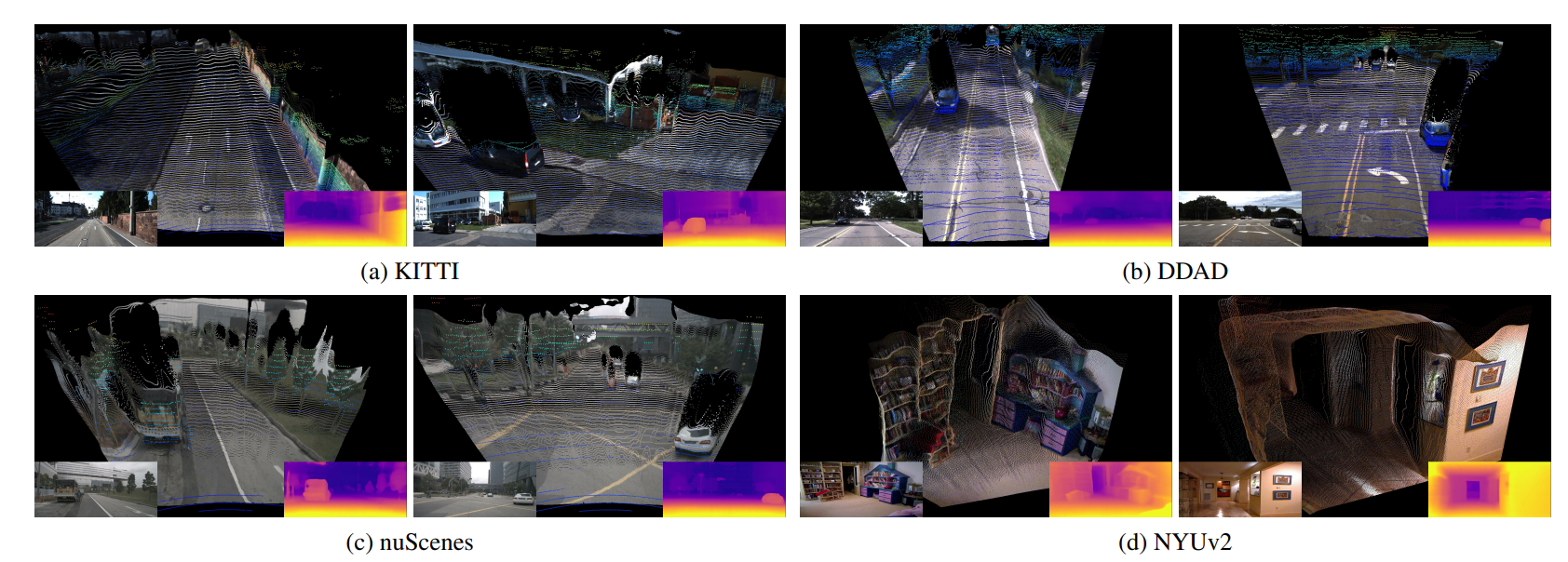
Differentiable volumetric rendering is a powerful paradigm for 3D reconstruction and novel view synthesis. However, standard volume rendering approaches struggle with degenerate geometries in the case of limited viewpoint diversity, a common scenario in robotics applications. In this work, we propose to use the multi-view photometric objective from the self-supervised depth estimation literature as a geometric regularizer for volumetric rendering, significantly improving novel view synthesis without requiring additional information. Building upon this insight, we explore the explicit modeling of scene geometry using a generalist Transformer, jointly learning a radiance field as well as depth and light fields with a set of shared latent codes. We demonstrate that sharing geometric information across tasks is mutually beneficial, leading to improvements over single-task learning without an increase in network complexity. Our DeLiRa architecture achieves state-of-the-art results on the ScanNet benchmark, enabling high quality volumetric rendering as well as real-time novel view and depth synthesis in the limited viewpoint diversity setting.
DeLiRa: Self-Supervised Depth, Light, and Radiance Fields
Vitor Guizilini, Igor Vasiljevic, Jiading Fang, Rares Ambrus, Sergey Zakharov, Vincent Sitzmann, Adrien Gaidon
ICCV 2023
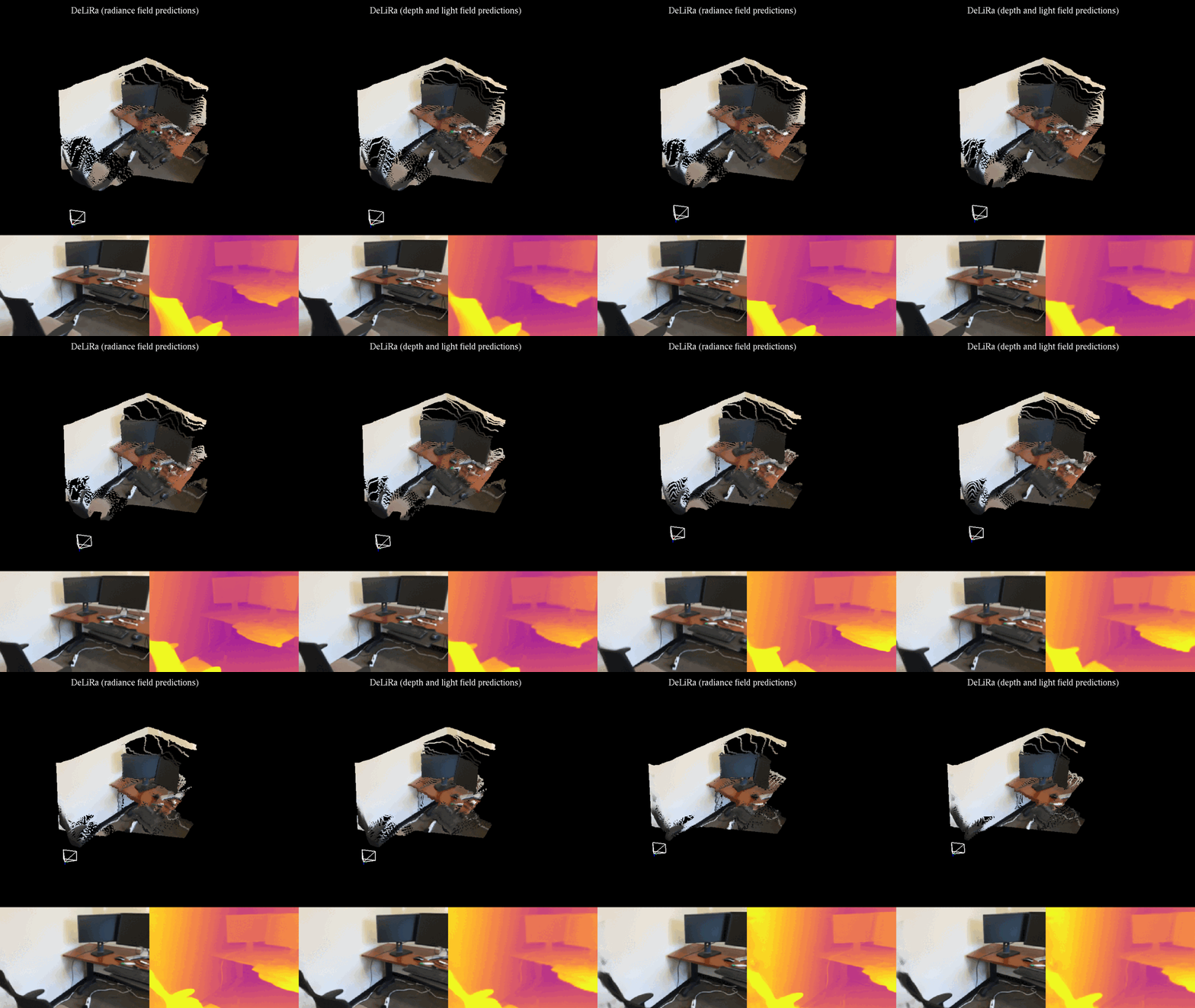
Differentiable volumetric rendering is a powerful paradigm for 3D reconstruction and novel view synthesis. However, standard volume rendering approaches struggle with degenerate geometries in the case of limited viewpoint diversity, a common scenario in robotics applications. In this work, we propose to use the multi-view photometric objective from the self-supervised depth estimation literature as a geometric regularizer for volumetric rendering, significantly improving novel view synthesis without requiring additional information. Building upon this insight, we explore the explicit modeling of scene geometry using a generalist Transformer, jointly learning a radiance field as well as depth and light fields with a set of shared latent codes. We demonstrate that sharing geometric information across tasks is mutually beneficial, leading to improvements over single-task learning without an increase in network complexity. Our DeLiRa architecture achieves state-of-the-art results on the ScanNet benchmark, enabling high quality volumetric rendering as well as real-time novel view and depth synthesis in the limited viewpoint diversity setting.
Viewpoint Equivariance for Multi-View 3D Object Detection
Dian Chen, Jie Li, Vitor Guizilini, Rares Ambrus, Adrien Gaidon
CVPR 2023
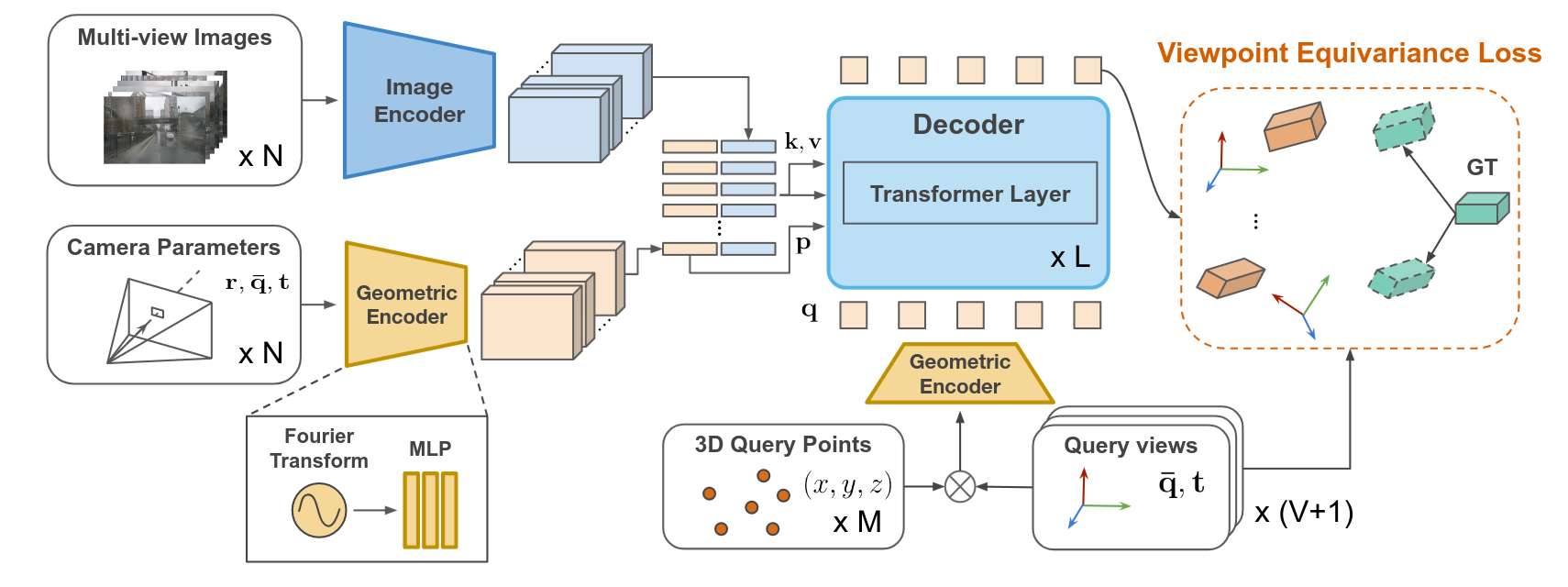
Autonomous vehicles and robots need to operate over a wide variety of scenarios in order to complete tasks efficiently and safely. Multi-camera self-supervised monocular depth estimation from videos is a promising way to reason about the environment, as it generates metrically scaled geometric predictions from visual data without requiring additional sensors. However, most works assume well-calibrated extrinsics to fully leverage this multi-camera setup, even though accurate and efficient calibration is still a challenging problem. In this work, we introduce a novel method for extrinsic calibration that builds upon the principles of self-supervised monocular depth and ego-motion learning. Our proposed curriculum learning strategy uses monocular depth and pose estimators with velocity supervision to estimate extrinsics, and then jointly learns extrinsic calibration along with depth and pose for a set of overlapping cameras rigidly attached to a moving vehicle. Experiments on a benchmark multi-camera dataset (DDAD) demonstrate that our method enables self-calibration in various scenes robustly and efficiently compared to a traditional vision-based pose estimation pipeline. Furthermore, we demonstrate the benefits of extrinsics self-calibration as a way to improve depth prediction via joint optimization.
Depth Field Networks for Generalizable Multi-view Scene Representation
Vitor Guizilini, Igor Vasiljevic, Jiading Fang, Rares Ambrus, Greg Shakhnarovich, Matthew Walter, Adrien Gaidon
ECCV 2022
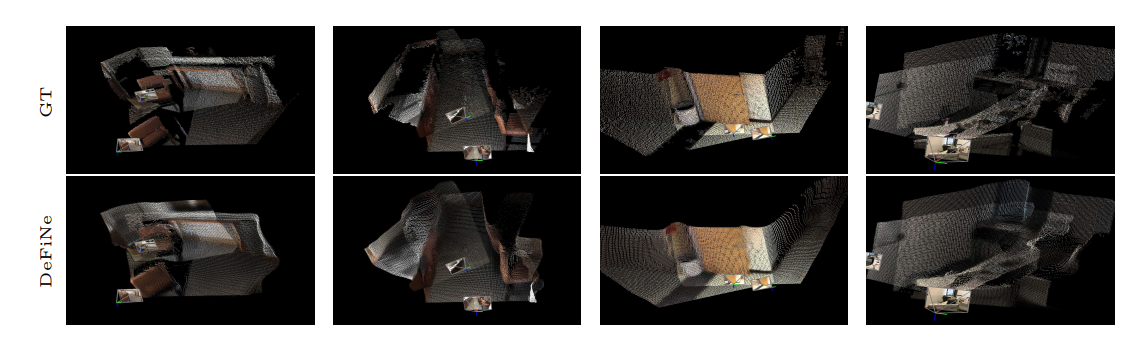
Modern 3D computer vision leverages learning to boost geometric reasoning, mapping image data to classical structures such as cost volumes or epipolar constraints to improve matching. These architectures are specialized according to the particular problem, and thus require significant task-specific tuning, often leading to poor domain generalization performance. Recently, generalist Transformer architectures have achieved impressive results in tasks such as optical flow and depth estimation by encoding geometric priors as inputs rather than as enforced constraints. In this paper, we extend this idea and propose to learn an implicit, multi-view consistent scene representation, introducing a series of 3D data augmentation techniques as a geometric inductive prior to increase view diversity. We also show that introducing view synthesis as an auxiliary task further improves depth estimation. Our Depth Field Networks (DeFiNe) achieve state-of-the-art results in stereo and video depth estimation without explicit geometric constraints, and improve on zero-shot domain generalization by a wide margin.
Is Pseudo-Lidar needed for Monocular 3D Object detection?
Dennis Park, Rares Ambrus, Vitor Guizilini, Jie Li, Adrien Gaidon
ICCV 2021
Recent progress in 3D object detection from single images leverages monocular depth estimation as a way to produce 3D pointclouds, turning cameras into pseudo-lidar sensors. These two-stage detectors improve with the accuracy of the intermediate depth estimation network, which can itself be improved without manual labels via large-scale self-supervised learning. However, they tend to suffer from overfitting more than end-to-end methods, are more complex, and the gap with similar lidar-based detectors remains significant. In this work, we propose an end-to-end, single stage, monocular 3D object detector, DD3D, that can benefit from depth pre-training like pseudo-lidar methods, but without their limitations. Our architecture is designed for effective information transfer between depth estimation and 3D detection, allowing us to scale with the amount of unlabeled pre-training data. Our method achieves state-of-the-art results on two challenging benchmarks, with 16.34% and 9.28% AP for Cars and Pedestrians (respectively) on the KITTI-3D benchmark, and 41.5% mAP on NuScenes.